World of Warcraft: Forever turns more than two decades of product evolution into a strategic experiment. An earlier version of a mature product can become the foundation for a different future.
On September 12, 2026, Blizzard Entertainment announced World of Warcraft: Forever, a new permanent experience within the World of Warcraft franchise. Blizzard describes Forever as a permanent home alongside Modern and Classic WoW, returning players to the original continents and the level 1–60 journey while introducing new stories, experiences, and updates over time (Blizzard Entertainment, 2026a). World of Warcraft: Forever is scheduled to launch globally on November 4, 2026.
World of Warcraft has always been a kind of time machine. Players enter Azeroth for a few hours and emerge having lived through journeys, friendships, discoveries, and routines that can remain with them for years. With World of Warcraft: Forever, that time machine is doing something even more unusual: it is turning toward its own past.
Since its launch in 2004, World of Warcraft has undergone more than two decades of continuous development. Expansions have added continents, stories, systems, classes, technologies, conveniences, and increasingly sophisticated forms of progression. That evolution produced the contemporary experience generally described as Modern WoW. Forever creates another permanent direction for the franchise. Blizzard describes it as a new permanent home alongside Modern and Classic WoW, returning players to the original continents and the level 1–60 journey while continuing to develop new stories, experiences, and updates over time (Blizzard Entertainment, 2026a). The strategic significance of Forever therefore comes from the relationship between two moments in WoW’s history. Blizzard has accumulated more than two decades of knowledge about how the product can evolve, while Forever gives the company an opportunity to revisit characteristics that existed much earlier in that evolution.
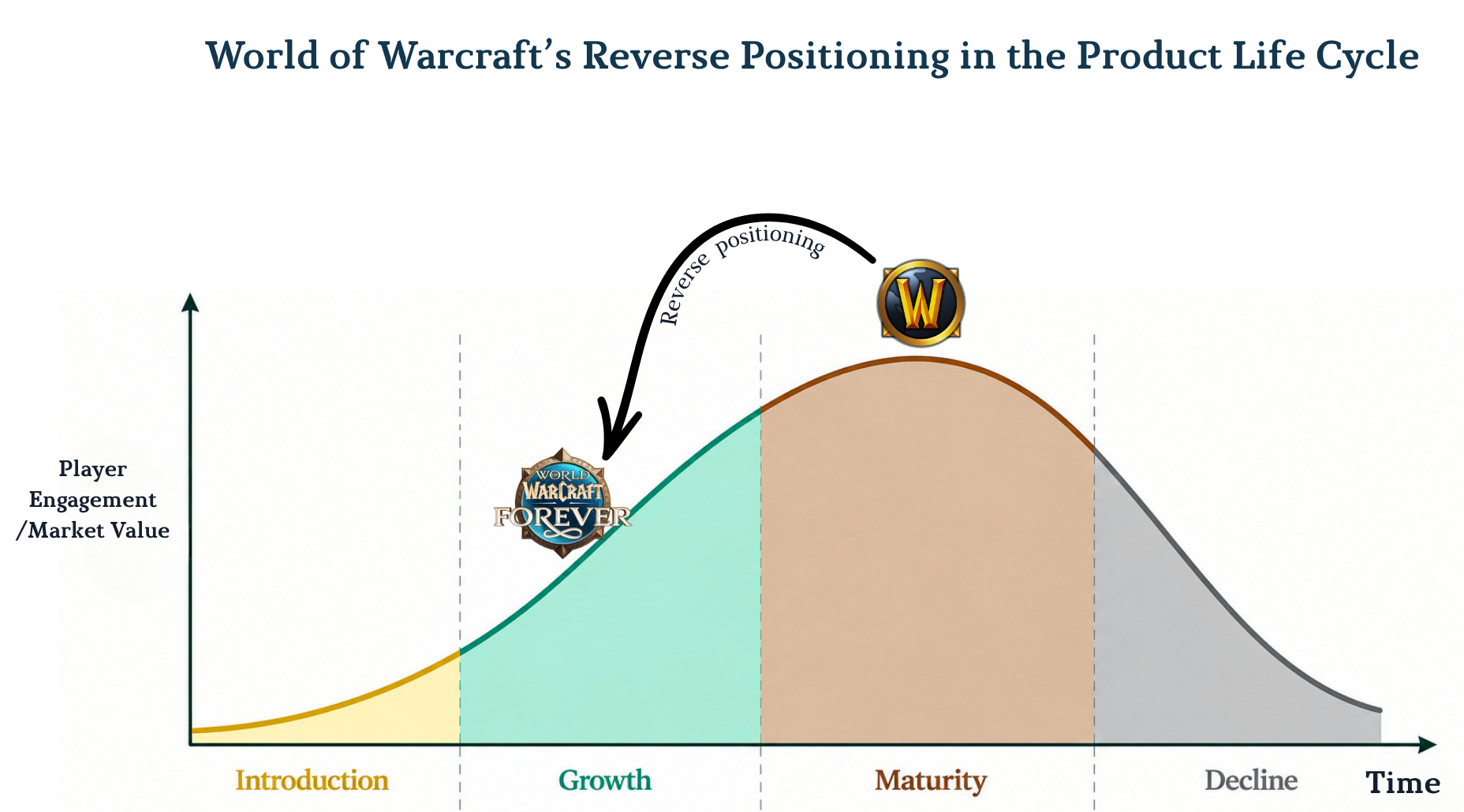
Products are commonly understood as moving through introduction, growth, maturity, and eventually decline. Moon argues that this model can constrain managerial thinking because mature products frequently enter what she calls an “augmentation treadmill.” Companies add features to differentiate themselves, customers gradually learn to expect those features, and yesterday’s enhancements become today’s basic requirements. Firms respond with additional enhancements, creating an ongoing cycle of augmentation (Moon, 2005). For a product that has existed for more than twenty years, this idea becomes particularly interesting. Continuous improvement can make the product richer and more capable while simultaneously transforming the experience that originally made it distinctive.
World of Warcraft provides an unusually rich setting for examining this problem because its evolution has changed far more than the quantity of available content. Faster travel changes the perceived size of the world. Streamlined progression changes the meaning of leveling. Easier coordination changes the role of social dependence. Greater content density changes the attention players can devote to individual places. Each improvement affects relationships among time, effort, discovery, interaction, and reward. After enough years, the accumulated contrast between earlier and later versions can itself become strategically valuable. Once customers experience what replaced an earlier product characteristic, the value of that characteristic can become easier to see.
Adner and Snow (2010) show how technological progress can make previously overlooked characteristics of an older technology newly visible. Their discussion of mechanical watches is particularly relevant. Quartz technology offered significant functional advantages, yet its success helped reveal another kind of value in mechanical watches. Mechanical complexity, craftsmanship, heritage, and the visible operation of the mechanism became meaningful sources of differentiation. Characteristics that had once been ordinary became more noticeable after customers experienced a technologically different alternative (Adner & Snow, 2010). The mechanism is one of contrast: change alters the reference point against which customers evaluate what came before.
A similar mechanism may help explain the opportunity behind Forever. Years of accelerated progression can make slower progression meaningful in a different way. Increased convenience can reveal the experiential role of friction. Automated coordination can make the social consequences of dependence easier to recognize. A vast library of accessible content can increase appreciation for inhabiting a smaller and more coherent world. These interpretations do not imply that every player prefers older mechanics or that every earlier design decision deserves restoration. They suggest that the perceived value of a product characteristic can change when the surrounding product changes. An attribute that once seemed ordinary can acquire strategic significance because customers now possess years of contrasting experience through which to interpret it.
The Strategic Logic Behind “World of Warcraft: Forever”
Blizzard’s explanation of Forever is consistent with this interpretation. The company says the project emerged from years of players imagining further adventures in the original world, lessons learned through WoW Classic and Season of Discovery, and community interest in what else might exist within original Azeroth (Blizzard Entertainment, 2026b). Forever therefore emerges after Blizzard has had opportunities to observe how players respond when earlier forms of WoW become accessible again. Classic demonstrated continued interest in historical configurations of the product, while Season of Discovery gave Blizzard experience introducing unfamiliar possibilities into a familiar foundation. Forever develops this logic further by establishing an earlier version of Azeroth as the basis for continued development.
Blizzard’s “found photographs” philosophy makes this especially interesting. The phrase describes an approach in which new material should feel as though it might have existed somewhere within original Azeroth all along. Blizzard describes Forever as occupying its own early period of Azeroth, giving developers room to explore new possibilities while working within the spirit and history of that world (Blizzard Entertainment, 2026c). The idea therefore extends beyond the familiar mechanism of nostalgia. The earlier version of Azeroth becomes a set of creative constraints. New locations, characters, conflicts, and stories have to remain intelligible within a world whose geography, visual language, history, and atmosphere are already familiar to players.
This distinction gives the past a more productive role. Nostalgia can create value through recognition, memory, and emotional association. The opportunity represented by Forever also lies in possibilities that were compatible with an earlier product architecture but were never developed because the main product subsequently moved elsewhere. Blizzard can now explore those possibilities with more than two decades of additional development experience and customer knowledge. The past becomes a bounded design space within which new development can occur. “Found photographs” therefore provides a bridge between historical continuity and innovation: the earlier architecture establishes what should feel plausible, while contemporary development determines which unrealized possibilities can finally be explored.
This also clarifies the difference between Classic and Forever. Classic gives players access to historical configurations of World of Warcraft. Its strategic value is closely connected to preservation and revisitation. Blizzard describes Forever as an evergreen experience that will continue expanding and states that it is neither a mode, a season, nor another version of Classic (Blizzard Entertainment, 2026b). Forever takes an earlier foundation and allows new development to proceed from it. A preserved product gives customers access to an earlier state. A branched product gives that earlier state another future.
Reverse Positioning: Returning to Move Forward
Reverse positioning involves reconsidering attributes that have become expected within a mature category and creating a different proposition through selective subtraction and carefully chosen additions (Moon, 2005). Applied to Forever, the concept suggests that decades of product development do not automatically determine which characteristics must appear in every future version of WoW. An alternative trajectory can reconsider assumptions accumulated during the product’s evolution and recover earlier principles that have acquired renewed strategic relevance.
The challenge is one of selective recovery. Age alone does not create value. Some older design decisions can contribute to discovery, anticipation, interaction, accomplishment, or attachment to place, while others can create boredom or unnecessary frustration. Blizzard therefore faces a difficult design problem in determining which forms of friction contribute meaningfully to the experience. Travel illustrates this tension. Reducing travel time improves efficiency, yet travel can establish geographical scale, produce encounters, create anticipation, expose players to unexpected places, and give destinations psychological distance. Similar tensions can exist around matchmaking, leveling speed, difficulty, resource scarcity, and dependence on other players. The value of convenience ultimately depends on what the product is trying to make meaningful.
Forsyth et al. (2000) demonstrate the danger of assuming that customers evaluate products primarily through basic functionality or price. In one industrial example, price represented 30% of the purchasing decision, while consistency accounted for 18%, technical support and service for 18%, on-time delivery for 14%, sales-representative contact for 10%, and selection for 10% (Forsyth et al., 2000). They also identified customer segments that placed substantially different weights on price, product characteristics, and service. Their empirical setting differs substantially from gaming, so these findings should not be interpreted as direct evidence of WoW player behaviour. Their broader strategic insight remains useful because managers can overlook important dimensions of customer value when they define the product too narrowly.
World of Warcraft itself possesses substantial differentiation through its intellectual property, lore, world, accumulated player investment, social relationships, and history. Across the MMORPG category, however, many functional elements have become familiar: levels, quests, classes, raids, dungeons, gear, progression systems, matchmaking, and endgame content. The strategic question therefore concerns how those elements are configured and experienced. Pace, discovery, social dependence, attachment to particular places, accomplishment, and the feeling of inhabiting a world can become important sources of differentiation. Forever gives Blizzard an opportunity to reorganize these relationships around an earlier design foundation while still drawing on contemporary development capabilities.
Pricing reinforces the strategy. Blizzard has announced that Forever will launch globally on November 4, 2026, and access will be included with an active World of Warcraft subscription or Game Time. Optional upgrade editions provide additional benefits and digital content (Blizzard Entertainment, 2026d). For existing subscribers, this reduces the incremental financial barrier to experimenting with the new experience. The customer decision can increasingly concern which version of World of Warcraft they want to inhabit. Modern, Classic, and Forever can therefore coexist within the broader WoW ecosystem while offering different interpretations of what makes the product valuable. Optional premium offerings can simultaneously capture additional willingness to pay from players who value the associated benefits.
The resulting portfolio creates an unusual form of temporal positioning. Modern WoW represents continued evolution along the franchise’s primary developmental trajectory. Classic allows players to revisit earlier configurations of the product. Forever takes an earlier foundation and develops another future from it. These propositions occupy different relationships with the same history. Modern explores where Warcraft can continue to go, Classic provides access to where Warcraft has been, and Forever explores what else Warcraft could become.
Giving an Earlier Product Another Future
This suggests an extension of the conventional product-life-cycle model that I call lifecycle branching. Lifecycle branching describes a strategy in which a mature brand retrieves an earlier configuration of its product, identifies characteristics within that configuration that retain or have acquired customer value, selectively incorporates contemporary capabilities, and develops the resulting proposition alongside the existing product trajectory. The concept becomes particularly relevant for digital products because earlier architectures can remain recoverable, communities can preserve knowledge and attachment around them, and historical assets can be recombined into new propositions.
Seen through lifecycle branching, the history of World of Warcraft resembles a tree more closely than a single lifecycle curve. Original WoW provides the historical foundation. More than two decades of expansions and development produced the trajectory that became Modern WoW. Classic makes earlier states accessible again. Forever, introduced within a mature franchise, reaches back toward an earlier architecture and uses it to create another developmental trajectory. Its launch belongs to the present, while its product foundation belongs to an earlier moment in WoW’s history. This distinction is essential because Forever itself did not originate during WoW’s original growth period. Blizzard is creating the branch now.
This also changes how maturity should be interpreted. There is insufficient evidence to conclude that Blizzard created Forever because Modern WoW is declining. Blizzard’s stated rationale emphasizes player interest, learning from Classic and Season of Discovery, and unrealized possibilities within original Azeroth (Blizzard Entertainment, 2026b, 2026c). A more defensible strategic interpretation is that Blizzard is attempting to create an additional growth opportunity from a mature franchise. Moon (2005) argues that repositioning can alter the trajectory available to mature products and potentially return them toward growth. Forever extends this possibility because the source of the new proposition exists within the product’s own history.
The Risk of Repeating the Same Cycle
The greatest challenge for lifecycle branching appears after the branch begins to grow. Forever will accumulate its own content, systems, conveniences, and customer expectations, which means Moon’s (2005) augmentation treadmill can begin again inside the new trajectory. A convenience introduced as an exception can become an expectation; a new system can require supporting systems; additional content can alter pacing, attention, and the relationship players have with the world. The branch therefore faces a paradox. It needs continued development to justify its existence as a living product, yet development can gradually weaken the characteristics that made returning to the earlier architecture valuable. If Forever eventually evolves according to the same assumptions that shaped Modern WoW, two initially different trajectories could begin converging.
That tension extends beyond product design. Interest in Classic shows that earlier configurations of WoW can continue to attract players, although it cannot establish how large or durable the audience will be for years of new development built around those principles. Adner and Snow (2010) similarly emphasize that recovering value from an older technology requires identifying who values its distinctive characteristics and whether that position can remain sustainable. Blizzard must therefore learn which recovered characteristics genuinely support an ongoing proposition while managing a portfolio in which Modern, Classic, and Forever may compete for some of the same player attention and organizational resources. This gives lifecycle branching an important boundary condition: the branch creates strategic value when its recovered architecture supports a meaningful audience and continued development can occur without dissolving the distinction that gave the branch a reason to exist.
The deeper possibility behind lifecycle branching lies in what mature products accumulate while moving forward. Every significant product decision opens certain possibilities and leaves others unexplored. Over decades, those unrealized paths can remain embedded in old systems, environments, narratives, customer memories, and design philosophies. They become what might be called abandoned futures: possibilities that belonged to an earlier version of the product but were never given the opportunity to develop. Forever is interesting because Blizzard is returning to one of those earlier architectures with more than twenty years of additional knowledge and asking what could still grow from it.
Mature brands possess something new brands cannot immediately acquire: contrast with their own past. Customers have experienced what changed. Managers can observe which earlier characteristics acquired new meaning after they disappeared or evolved. Communities have had years to reinterpret previous experiences. Product evolution therefore generates knowledge about the paths a company took and, potentially, about the paths it left behind.
For mature brands, the past can become a strategic toolkit. World of Warcraft has spent more than two decades acting as a time machine for its players. With Forever, Blizzard is turning the machine toward Warcraft itself. And this time, going back opens a road that was never travelled forward.
References
Adner, R., & Snow, D. C. (2010). Bold retreat: A new strategy for old technologies. Harvard Business Review, 88(3), 76–81.
Blizzard Entertainment. (2026a, September 12). Carve a new path with World of Warcraft: Forever. World of Warcraft. https://worldofwarcraft.blizzard.com/en-gb/news/24302093
Blizzard Entertainment. (2026b, September 12). World of Warcraft: Forever—What’s next panel recap. World of Warcraft. https://worldofwarcraft.blizzard.com/en-us/news/24303862/world-of-warcraft-forever-whats-next-panel-recap
Blizzard Entertainment. (2026c, September 13). World of Warcraft: Forever—Found photos panel recap. World of Warcraft. https://worldofwarcraft.blizzard.com/en-gb/news/24304071/world-of-warcraft-forever-found-photos-panel-recap
Blizzard Entertainment. (2026d, September 12). Pre-purchase World of Warcraft: Forever upgrades and begin your next journey in Azeroth. World of Warcraft. https://worldofwarcraft.blizzard.com/en-gb/news/24301508
Forsyth, J. E., Gupta, A., Haldar, S., & Marr, M. V. (2000). Shedding the commodity mind-set. The McKinsey Quarterly, (4), 78–85.
Moon, Y. (2005). Break free from the product life cycle. Harvard Business Review, 83(5), 86–94.


Leave a comment