
Two composers can inherit the same musical language and still produce remarkably different experiences. Joseph Haydn and Wolfgang Amadeus Mozart worked within the conventions of eighteenth-century Classical music and drew on many of the same formal structures, including sonata form, rondo, variation, and minuet and trio. Sonata form was particularly important because it provided a flexible architecture through which musical ideas could establish stability, depart from it, develop, and return (Caplin, 1998). Yet saying that Haydn and Mozart both used sonata form explains surprisingly little about what their music actually does to a listener. Form establishes possibilities; individuality emerges partly from what a composer does within them.
Haydn is especially revealing because he frequently makes expectation itself part of the musical experience. Formal functions can be displaced, extended, recomposed, or made temporarily ambiguous. Riley (2015) demonstrates the flexibility of Haydn’s recapitulatory strategies after 1770, while Neuwirth (2013) examines the so-called “false recapitulation” through the expectations generated by Classical formal conventions. Burstein (2021) similarly explores Haydn’s tendency to twist conventional formal functions, reinforcing the importance of temporality and expectation in understanding his music. Haydn’s inventiveness therefore offers a useful principle: convention provides the reference against which deviation becomes meaningful.
Mozart offers a complementary perspective. Sonata form was extraordinarily flexible in his hands, accommodating themes of contrasting character, textures, harmonic relationships, phrase structures, and musical topics (Irving, 2009). Scholarship examining Mozart’s sonata-form expositions has emphasized the importance of contrast within their organization (Webster, 2008). In Mozart’s operatic writing, musical form and dramatic meaning are also closely integrated; harmonic and formal contrasts can participate directly in the construction of dramatic tension (Steptoe, 1990). Recent scholarship continues to situate Mozart’s formal ingenuity within his engagement with Classical convention and with Haydn (Carter, 2025).
Both composers manipulate convention, create contrast, generate surprise, and exploit formal expectations, although they often place different expressive weight on these possibilities. Haydn provides an especially productive model for understanding expectation within structure, where established conventions create opportunities for meaningful deviation. Mozart provides a complementary model of contrast within coherence, where differentiated musical ideas acquire expressive force through their relationship to a larger formal whole. Together, these approaches offer an unexpected way of thinking about how brands create difference while preserving structural coherence.
From Musical Form to Brand Form
Brands are commonly represented through identifiable elements such as names, symbols, logos, colors, packaging, typography, slogans, and other visual or verbal cues. They are also experienced through products, communications, interfaces, retail environments, services, and other touchpoints. Their strategic significance depends partly on the relationships connecting these expressions and experiences. In music, form emerges through relationships: what appears first, what returns, what changes, what contrasts, what is delayed, and what eventually resolves. A similar perspective can be applied to brands. Brand form can be understood as the relational system through which a brand organizes its elements, experiences, meanings, contrasts, and deviations over time.
This changes the strategic question. Alongside what a brand looks like and what it communicates, we can ask how it behaves structurally. Which patterns recur? Which elements are allowed to change? What does an audience come to expect? When should that expectation be fulfilled, and when might departing from it create value? How can different experiences remain recognizably connected while performing different functions? Brand form shifts attention from individual elements and encounters toward the relationships among them.
The Brand Form Framework
The Haydn–Mozart comparison suggests two dimensions within this idea. The first, expectation manipulation, concerns how a brand works with established expectations by confirming, delaying, reversing, exaggerating, or violating them. The second, experiential dramaturgy, concerns how different encounters with a brand perform distinct functions within a larger experiential progression. One dimension concerns what happens relative to expectation; the other concerns how differentiated experiences relate to the whole.
Together they produce the Brand Form Framework. Brands low in both dimensions rely heavily on repetition and predictable execution. Greater expectation manipulation produces a Haydnian tendency: recognizable conventions become material for controlled deviation. Greater experiential dramaturgy produces a Mozartian tendency: differentiated encounters acquire meaning through their relationship to a coherent whole. A brand can also combine both, using surprise while integrating that surprise into a larger experiential progression. These positions describe strategic possibilities that can shift across campaigns, touchpoints, categories, markets, and periods.
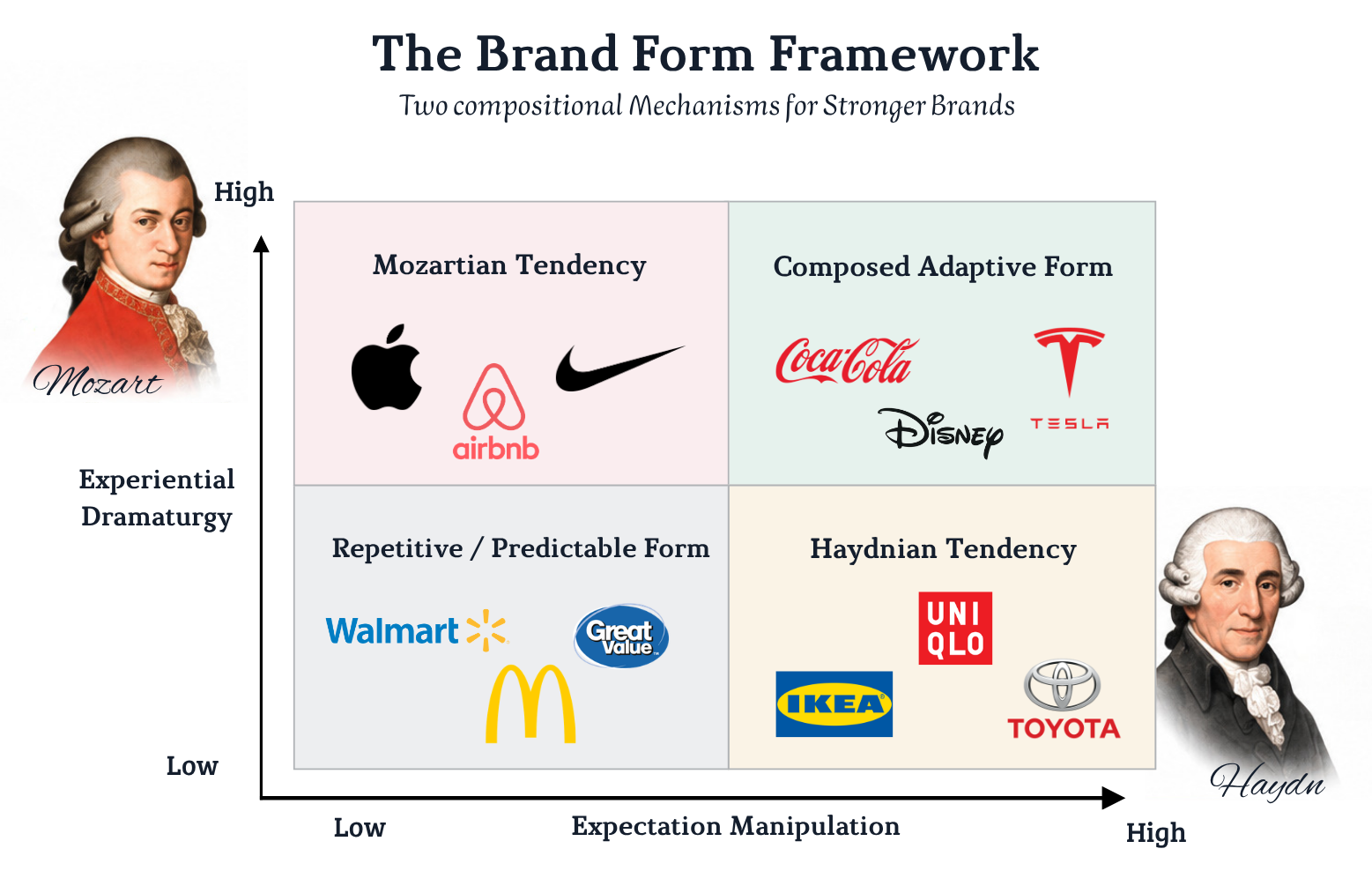
At the center of the framework is a tension. Variation needs some degree of stability to be interpreted, while excessive stability eventually limits what variation can accomplish. This is the Brand Form Paradox. A brand must establish enough structure for audiences to understand what belongs to it while preserving sufficient flexibility for meaningful change. The strategic problem concerns the organization of consistency and creativity within the same system.
Haydn: Expectation as Strategic Material
Research on expectancy violation helps explain the Haydnian side of this argument. Unexpectedness becomes consequential because an expectation already exists, and consumer responses depend heavily on the meaning assigned to its violation. Saeed et al. (2024), examining luxury-brand relationships, found that violations of consumers’ expectations can contribute to perceived betrayal and subsequent negative behaviors. Schumacher et al. (2025) similarly found that presenting an experience as surprising can encourage initial choice while reducing subsequent consumption when the actual experience fails to justify the promised surprise. Disruption therefore acquires its strategic value from the expectation being disturbed and the consumer’s interpretation of that deviation.
A Haydnian approach consequently depends on disciplined manipulation of convention. The brand first needs to understand the pattern that gives a deviation its meaning. IKEA offers a simple illustration. Furniture retail remains recognizable, while familiar relationships within it are reorganized: customers travel through staged domestic environments, retrieve products themselves, transport them, and frequently complete final assembly. The distribution of activities changes while the category remains intelligible. IKEA illustrates how differentiation can emerge by recomposing familiar conventions.
Mozart: Difference Within Coherence
The Mozartian side concerns the organization of difference across experience. Brand encounters unfold over time, and individual encounters can perform distinct functions. Discovery, purchase, unboxing, product use, service, and renewal may create different experiences while contributing to the same larger identity. Their strategic value depends partly on whether consumers can perceive an intelligible relationship among them.
Research on narrative transportation provides a useful parallel. Thomas and Grigsby’s (2024) systematic review of 95 peer-reviewed studies describes narrative transportation as immersion in a story world and synthesizes research connecting it with outcomes including attitudes, intentions, choice, and word of mouth. Deb et al. (2025) further found that narrative transportation and retrospective reflexivity can mediate the relationship between storytelling advertising and attitudes toward brands. These findings concern narrative processes, while their relevance here lies in the broader principle that the organization and progression of experience can influence how marketing communication is processed.
Apple provides an illustration of this Mozartian tendency. A product presentation, package, interface, advertisement, retail environment, and service encounter can serve different functions while remaining recognizably connected. Anticipation can give way to revelation, interaction, and continued use, with each stage contributing something different to the larger experience. Apple therefore illustrates the possibility of creating coherence through differentiated encounters.
This perspective expands conventional discussions of brand consistency. Consistency is often expressed through repeated colors, typography, logos, layouts, or tone. Those devices can support recognition, while coherence can also emerge at a deeper relational level. Music makes this especially visible. A symphony can sustain unity across movements that differ substantially in melody, tempo, instrumentation, and emotional character. Relationships among differentiated parts provide another source of coherence. Under the right structure, variation can strengthen the integrity of the whole.
Brand Grammar and Permitted Variation
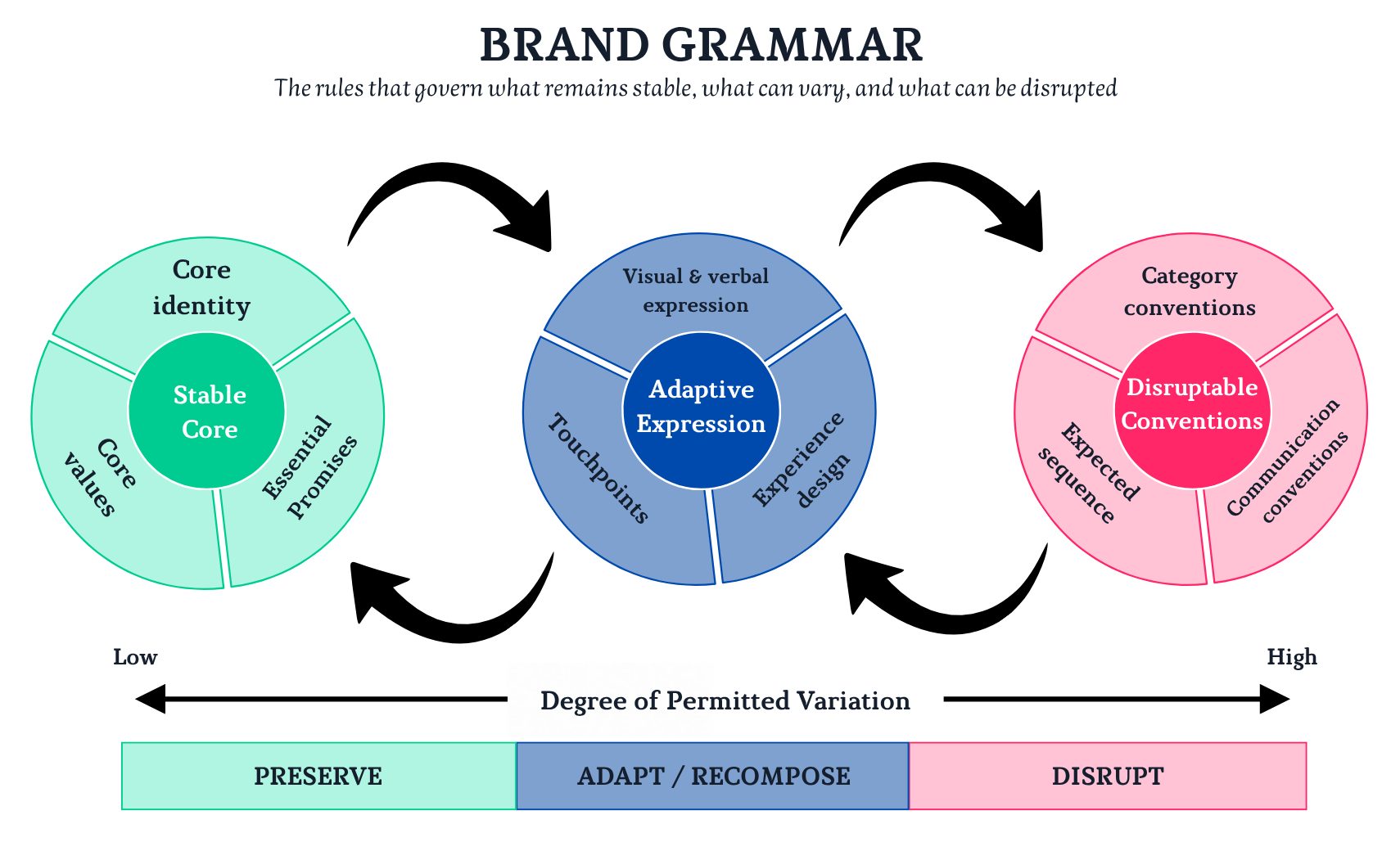
This is where brand grammar becomes useful. Brand identity describes what a brand seeks to represent; brand grammar governs the range and character of variation through which that identity can be expressed while remaining intelligible. Like linguistic grammar, it establishes relationships and constraints that make variation comprehensible. Within a brand, these constraints can be organized across three domains of permitted variation: stable core, adaptive expression, and disruptable conventions.
The stable core contains elements whose continuity anchors recognition and trust, including core identity, core values, and essential promises. Adaptive expression provides greater latitude across visual and verbal expression, touchpoints, and experience design. Here, brands can adapt or recompose existing expressions while preserving coherence. Disruptable conventions include aspects of category convention, expected sequences, and communication conventions that may sustain greater departures from established practice. Together, these domains represent increasing latitude for variation, from preservation through adaptation and recomposition to deliberate disruption.
These domains specify permission rather than behavior. They indicate how much variation a particular element, expression, or convention may plausibly sustain; they do not determine how much expectation manipulation a brand will actually employ. Expectation manipulation remains a dimension of brand form: it describes the extent to which a particular execution confirms, delays, reverses, exaggerates, or violates an established expectation. Brand grammar establishes the boundaries within which those choices occur. A category convention classified as disruptable may offer substantial latitude for expectation manipulation, yet a brand may still choose to preserve it. An essential promise located within the stable core offers far less latitude, making aggressive manipulation potentially damaging. The framework therefore separates the range of permissible variation from the strategic use of variation.
These classifications are contextual rather than universal. Packaging may function as adaptive expression for one brand and become part of the stable core for another. A category convention may remain highly disruptable until it intersects with expectations involving safety, trust, product performance, or explicit promises. Saeed et al.’s (2024) findings demonstrate why this boundary matters: expectation violations can become relationally consequential when consumers interpret them as betrayal. Brand grammar therefore helps managers determine how much variation a particular element, expression, or convention can sustain before experimentation begins to threaten the larger brand form.
Experiential dramaturgy requires similar restraint. Different categories and situations demand different experiential functions. Speed, clarity, reliability, or simplicity may be central to the experience consumers value. Dramaturgy, in this framework, refers to the capacity of different encounters to perform distinct roles within an intelligible whole. A Mozartian approach therefore uses contrast selectively, allowing different moments to contribute appropriately to the larger experience.
From Concept to Testable Theory
These ideas also make the Brand Form Framework empirically testable. The musical analogy generates the concepts, while empirical research can determine whether the proposed relationships hold in consumer contexts. Four propositions follow from the framework.
Proposition 1: The effect of expectation manipulation on consumer response will depend on the strength and accessibility of the prior expectation being manipulated. A deviation from a weak or poorly established expectation may have little interpretive significance because consumers lack a sufficiently clear reference against which to evaluate it. As expectations become more established, deviations should become more perceptible and potentially more consequential. The direction of that consequence should depend on the nature of the expectation and the interpretation assigned to its violation. This proposition follows from the central logic of expectancy violation, where deviation acquires meaning in relation to an anticipated pattern (Saeed et al., 2024; Schumacher et al., 2025).
Proposition 2: The positive effect of experiential differentiation will depend on perceived coherence among brand encounters. Increasing differentiation among touchpoints should create greater experiential value when consumers perceive an organizing relationship among those encounters. Differentiated functions can then contribute to a richer whole. As perceived coherence declines, variation should increasingly be experienced as fragmentation. Experiential dramaturgy therefore predicts an interaction between differentiation and perceived coherence.
Proposition 3: A clearer perceived brand grammar will increase consumers’ capacity to integrate variation that remains within the brand’s perceived boundaries of permissible change. When consumers understand the deeper organizing logic of a brand, substantial variation in adaptive expressions or disruptable conventions may remain intelligible as part of the same system. Variation affecting elements perceived as part of the stable core should be more likely to reduce coherence. Brand grammar therefore moderates the relationship between executional variation and perceived coherence according to the type of element, expression, or convention being changed.
Proposition 4: Experiential dramaturgy will moderate responses to expectation manipulation by providing a larger structure through which deviations can be interpreted. A surprising brand encounter that performs an intelligible role within a broader experiential progression should be easier to integrate into the brand experience than an equivalent deviation with little apparent relationship to surrounding encounters. This proposition connects the Haydnian and Mozartian dimensions and predicts that the meaning of surprise depends partly on the experiential structure into which it is introduced.
These propositions give expectation manipulation and experiential dramaturgy distinct but interacting roles within brand form. Brand grammar defines the field of permissible change. Expectation manipulation describes how brands strategically work with expectations within that field. Experiential dramaturgy organizes differentiated encounters across the larger experience. Perceived coherence reflects whether consumers continue to experience those variations as belonging to the same brand. The concepts therefore operate at different levels of the same system.
The framework also creates a research agenda. Expectation strength could be manipulated experimentally by exposing participants to more or less stable brand patterns before introducing a deviation. Experiential dramaturgy could be examined by varying whether sequential touchpoints perform differentiated but complementary functions or reproduce similar functions. Researchers could then measure perceived coherence and consumer responses across those conditions.
Brand grammar presents a particularly interesting empirical problem because consumers may infer its rules gradually rather than encounter them explicitly. Experimental designs could manipulate both the type of brand material being changed and the degree of variation applied to it. Comparable degrees of variation could be introduced to something associated with the stable core, adaptive expression, or disruptable conventions. Researchers could then examine whether variation produces different effects on perceived coherence, trust, surprise, and brand evaluation according to its perceived position within the brand’s grammar. Longitudinal designs would be especially valuable because these boundaries, like musical expectations, may develop through repeated exposure over time.
This also creates an important distinction between brand grammar as understood by managers and brand grammar as inferred by consumers. Managers may regard a particular expression or convention as available for experimentation, while consumers may experience it as fundamental to the brand. The strategically relevant boundary ultimately depends on consumer interpretation. A brand can therefore violate its own grammar unintentionally when managerial assumptions about permissible variation diverge from the rules consumers have learned through previous encounters.
Context should shape these boundaries as well. A utilitarian service may derive substantial value from predictability. Highly regulated categories may provide little latitude around expectations involving safety or performance. Cultural, entertainment, fashion, or experiential brands may permit much broader variation. Even within the same brand, the degree of permissible change can differ across touchpoints and over time. Brand grammar should therefore be treated as a relational and evolving structure rather than a permanent classification. The broader framework likewise treats expectation manipulation and experiential dramaturgy as dimensions whose appropriate levels depend on category, relationship, touchpoint, and strategic objective.
Managing the Brand as a Composition
This perspective also changes how differentiation itself is understood. Difference acquires strategic meaning through relationship. Haydn’s surprises gain significance because listeners possess expectations about what could occur. Mozart’s contrasts gain expressive force because differentiated musical ideas participate in a larger formal architecture. In both cases, originality emerges through the organization of relationships.
For brands, this leads to a more demanding question than simply asking how to be different: Different from what, at what moment, for what purpose, and within what structure? A deviation from category convention may create intrigue in one context and distrust in another. A dramatic shift between touchpoints may enrich an experience when those touchpoints remain connected and produce fragmentation when the organizing relationship becomes unclear. Strategic differentiation therefore requires an understanding of the larger form in which difference occurs.
Haydn and Mozart offer two complementary ways of understanding this relationship between creativity and convention. Haydn demonstrates how expectations generated by a recognizable structure can become creative material. Mozart demonstrates how contrast can intensify experience while preserving coherence. Translated into branding, these become expectation manipulation and experiential dramaturgy: two dimensions through which brands can organize meaningful variation.
Strong brand form provides continuity while preserving room for change. Brand grammar establishes where that room exists and how far particular elements, expressions, and conventions may move. Expectation manipulation determines how brands use that freedom relative to what audiences anticipate. Experiential dramaturgy determines how differentiated encounters contribute to the larger experience. Managing a brand as a composition therefore requires an understanding of what belongs to the stable core, what can be adapted or recomposed through expression, which conventions can sustain disruption, and how those choices continue to belong to the same whole.
Consistency makes a brand recognizable. Form determines what that brand can meaningfully do with recognition.
References
Burstein, L. P. (2021). “Functial formanality”: Twisted formal functions in Joseph Haydn’s symphonies. In J. Pedneault-Deslauriers, N. J. Martin, & S. Vande Moortele (Eds.), Formal functions in perspective: Essays on musical form from Haydn to Adorno. University of Rochester Press.
Caplin, W. E. (1998). Classical form: A theory of formal functions for the instrumental music of Haydn, Mozart, and Beethoven. Oxford University Press.
Carter, T. (2025). Mozart: A tale of two keys. Oxford University Press.
Deb, M., Ghosh, A., & Shukla, Y. (2025). Storytelling ads, narrative transportation, retrospective reflexivity, and attitude towards brands: Role of independent versus interdependence self-construal. Psychology & Marketing, 42, 1795–1810.
Irving, J. (2009). Eighteenth-century views of sonata form. In Mozart’s piano sonatas: Contexts, sources, style. Cambridge University Press.
Neuwirth, M. (2013). Surprise without a cause? “False recapitulations” in the Classical repertoire and the modern paradigm of sonata form. Zeitschrift der Gesellschaft für Musiktheorie, 10(2), 259–291.
Riley, M. (2015). The sonata principle reformulated for Haydn post-1770 and a typology of his recapitulatory strategies. Journal of the Royal Musical Association, 140(1), 1–39.
Saeed, N., Akhtar, N., Attri, R., & Yaqub, M. Z. (2024). How violation of consumers’ expectations causes perceived betrayal and related behaviors: Theoretical perspectives from expectancy violation theory. Journal of Retailing and Consumer Services, 81, 103961.
Schumacher, L. M., et al. (2025). Revisiting surprise appeals: How surprise labeling curtails consumption. Journal of Consumer Psychology.
Steptoe, A. (1990). Drama and musical form in Le nozze di Figaro. In The Mozart–Da Ponte operas: The cultural and musical background to Le nozze di Figaro, Don Giovanni, and Così fan tutte. Oxford University Press.
Thomas, V. L., & Grigsby, J. L. (2024). Narrative transportation: A systematic literature review and future research agenda. Psychology & Marketing, 41, 1805–1819.
Webster, J. (2008). A metaphoric model of sonata form: Two expositions by Mozart. In D. Mirka & K. Agawu (Eds.), Communication in eighteenth-century music. Cambridge University Press.


Leave a comment