Ask me what Amazon does and my first thought is a package at the door. Ask Amazon’s income statement the same question, and you get a very different answer. In Q3 2026, Amazon Web Services (AWS) generated 63.3% of Amazon’s global operating profit on 22.8% of its net sales. In the same quarter, Amazon delivered more than 1.5 billion items worldwide to Prime members on the same day or overnight. One figure describes the financial weight of selling computing infrastructure. The other describes the scale of an experience that can put Amazon on a shopper’s mind tomorrow (Amazon.com, Inc., 2026e, 2026f).
The interesting question is why these two achievements have so little to say about each other from the customer’s point of view. A package arriving before dinner can change my opinion of Amazon as a place to shop. It gives me little basis for judging AWS as a cloud provider. Amazon operates businesses that can each build strong reputations without making the Amazon name mean something more specific across all of them. Disney makes that distinction easier to see.
What shoppers actually say about Amazon
When Remazing and Appinio (2025, p. 29) asked 5,678 respondents why they shop at Amazon, 69% cited fast delivery and 54% cited convenience. Product variety and lower prices each drew 49%. Respondents could cite more than one reason. This is direct evidence that speed is a benefit shoppers associate with using Amazon across the six markets studied. It measures stated reasons for shopping, so it leaves open what comes to mind first when people hear the Amazon name.
The 2026 edition surveyed 6,000 consumers across France, Germany, Italy, Spain, the United Kingdom, and the United States. It found that 52% cited price as a reason to visit Amazon, ahead of product research and customer reviews at 43% each. Visiting and shopping are different actions, and the surveys asked different questions. A shopper can open Amazon to check a price and choose to buy there because the item will arrive tomorrow. That distinction gives speed a more precise role in the brand argument. It can help explain why customers choose Amazon without explaining every reason they turn to it (Appinio, 2026; Remazing & Appinio, 2025).
YouGov’s U.S. tracking gives a sharper picture of what Amazon is good at. Amazon ranked first overall in its 2026 U.S. brand rankings, based on 2025 tracking. Its satisfaction score was 63.1, while its reputation score was 37.2. These are index scores. YouGov’s reputation measure asks whether people would be proud or embarrassed to work for a company, which gives it a different meaning from satisfaction as a customer. The gap suggests that being useful to shoppers and being admired as an employer are distinct outcomes. It also shows why calling Amazon a universally weak brand would miss the evidence (Dsouza, 2026; YouGov, 2026).
Disney shows why size is the wrong suspect
A film, a theme park attraction, and a toy are different products. A Disney character can connect all three. A story gives the character meaning, a park gives people a way to step into that story, and a toy gives them a piece of it to take home. Familiarity built in one place can make the experience in another more valuable. Disney’s portfolio also includes distinct brands and businesses, such as ESPN. The example here is the part of its portfolio where the Disney name and its stories can carry meaning across categories (The Walt Disney Company, 2025).
Amazon can do something similar within its shopping business. A useful delivery experience can increase the perceived value of Prime, while Prime gives shoppers another reason to start their next search on Amazon. The connection from a Prime delivery to a cloud contract is harder to see. A procurement team needs evidence about reliability, security, cost, and technical fit. Its members might all shop on Amazon. Their familiarity with the name may help it get recognized, but their shopping experience provides little evidence about how AWS will perform.
Keller (1993) separates brand awareness from brand image. Awareness is the ability to recognize or recall a name. Image is what the name brings to mind. Customer-based brand equity exists when that knowledge changes how someone responds to an otherwise identical offer. This is a tougher test than asking whether someone recognizes Amazon. A cloud buyer might recognize the name instantly and still evaluate AWS on the strength of its own track record.
Keller (1993) also asks whether associations are strong, favourable, and unique. Repeated fast deliveries can make the link between Amazon and speed stronger. The shopper survey suggests speed is valued, but it cannot tell us whether shoppers associate speed with Amazon more strongly than with rival stores. Even if all three conditions hold in shopping, the association still has to be relevant to the new decision. A cloud buyer may interpret Amazon’s scale as evidence that it can handle heavy demand. The same buyer could see Amazon’s involvement in retail as a potential conflict if their own company competes with it. Those are hypotheses about transfer in opposite directions. A famous name can raise familiarity while leaving the reasons to buy unchanged.
What the profit figures reveal about Amazon
The 63.3% figure is more striking once we understand the other 36.7%. It came from North America and International combined, the reporting segments that encompass direct retail, seller services, advertising, and subscriptions such as Prime. Amazon publishes revenue for several of those activities, but the filings give operating profit at the segment level. Calling the rest of the profit “retail profit” hides how many businesses AWS outweighed that quarter (Amazon.com, Inc., 2026d, 2026e).
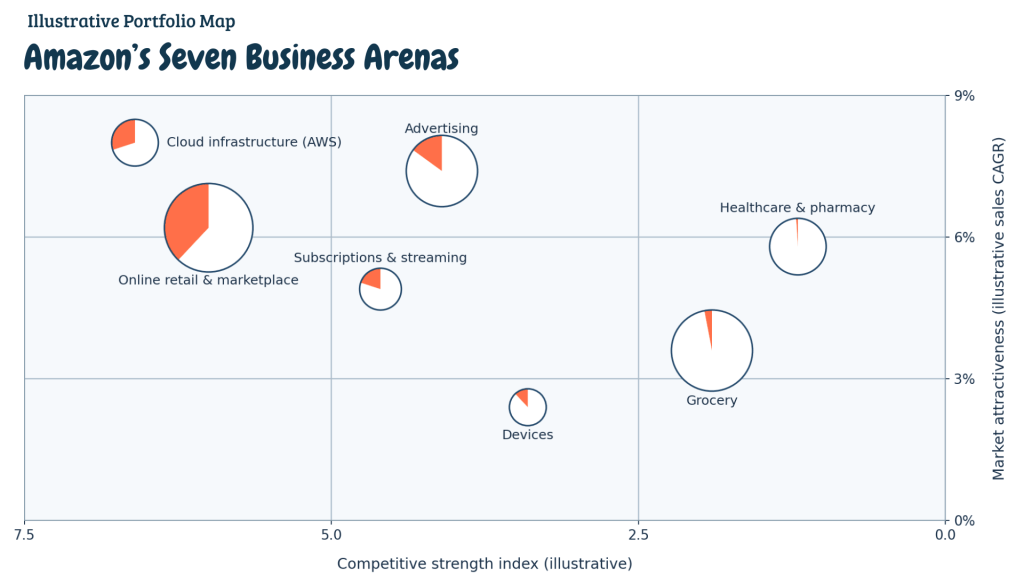
There is also a historical pattern behind the quarter. AWS accounted for about 67% of Amazon’s operating profit in 2023, 58% in 2024, and 57% in 2025. Its operating profit rose from $24.6 billion to $45.6 billion over those two years, even as its share fell. The other segments grew faster from a smaller base. That matters because Amazon can strengthen its cloud business and its shopping business at the same time. The financial figures describe each business’s contribution to the company. How customers recognize and value those businesses takes a different kind of evidence (Amazon.com, Inc., 2026d).
Aaker and Joachimsthaler’s (2000) brand relationship spectrum distinguishes a branded house, where the master brand largely drives choice, from a house of brands, where individual brands do that work. Between those ends, a subbrand can share the work with the master brand, or an endorsed brand can make its own promise while drawing credibility from the parent. Their idea of the driver role makes this practical. Which name does a customer credit when explaining the purchase or describing the experience?
Amazon’s portfolio can occupy different points on that spectrum. Amazon and Prime plausibly share the driver role in shopping. Amazon may be where a shopper starts a search, while Prime’s delivery benefit helps decide where the shopper completes it. AWS is visibly linked to the parent through the full name Amazon Web Services. In a cloud purchase, though, AWS may do most of the work of driving consideration, with the Amazon connection serving more as an endorsement in practice. These are interpretations of how the names might function. The naming and ownership establish the connection. Buyer evidence would establish which name actually drives choice (Aaker & Joachimsthaler, 2000).
That distinction exposes a trade-off. Letting AWS carry a distinct technical identity can keep the promise clear to enterprise buyers, while retaining the Amazon link can signal the resources behind it. The link also gives perceptions of Amazon a route into an AWS evaluation. Whether that helps, hurts, or matters little can vary by buyer and purchase. The portfolio may have a coherent architecture even when its brands create very different associations.
AWS also has a substantial presence with the audience that matters to its business. In Flexera’s 2026 survey of 753 cloud practitioners and decision-makers, 83% reported running at least some workloads on AWS. That is usage among the professionals surveyed. It gives us grounds to question the idea that AWS is an obscure business, while leaving open how much the Amazon name influenced adoption. Putting this alongside the shopper evidence gives us two distinct audiences that engage with the company for different reasons (Flexera, 2026).
That separation raises a question about what Amazon gains from putting its name on a new business. If the name carries an expectation the new offer can fulfil, it may lower the work of earning trust. If the new offer still has to establish its value from scratch, Amazon gains familiarity while doing much of the work of building a distinct brand. Shared technology and operating expertise can make two businesses fit together inside the company. Customers have to see a benefit for that fit to matter outside it. Prime and AWS may make sense together in an organization chart while asking for entirely different kinds of trust in the market.
Fast delivery is a branding decision
Amazon reported more than 7 billion items delivered to Prime members worldwide on the same or next day in 2023, more than 9 billion in 2024, and more than 13 billion in 2025. The 1.5 billion-plus figure for Q3 2026 refers to a different period and delivery window, same day or overnight. Together, the figures show the scale at which Amazon can let customers experience its promise of convenience. They count items, so they leave open how many individual shoppers changed their opinion of Amazon (Amazon.com, Inc., 2025c, 2026c, 2026f; Jassy, 2024).
Imagine running out of cat food before dinner. If Amazon can deliver tomorrow, it can compete for your next planned purchase. If it can deliver before dinner, it can compete for the trip you were about to make to a nearby store. The difference is a change in when Amazon comes to mind. Faster shipping can expand the situations in which the brand is considered. That helps explain why Amazon would invest in delivery even when AWS contributes more operating profit. If it wins the purchase, it earns another chance to make the membership useful and the store worth returning to. The reports do not isolate the incremental profit, renewals, or advertising revenue generated by faster delivery.
There is a vulnerability in building a brand around convenience. Customers learn the promise from every step of the experience, including how easy it is to leave. In 2025, Amazon agreed to a $2.5 billion U.S. settlement resolving Federal Trade Commission allegations about Prime enrollment and cancellation practices. The settlement illustrates how a membership built around making shopping easier can draw scrutiny over whether it gives customers enough control over the membership itself. A delivery can be fast, and the overall experience can still feel inconvenient at precisely the point where the customer wants to exercise a choice (Federal Trade Commission, 2025).
Where country differences matter
Amazon Canada reported more than 450 million items delivered to Prime members on the same or next day in 2025 and promoted wider access to afternoon delivery windows. Amazon Bazaar in India emphasizes low prices, but Amazon India also promotes fast Prime delivery and offers Amazon Now in select cities. In the UAE, Amazon Now advertised delivery in about 15 minutes for eligible essentials. These examples suggest that Amazon can put different benefits in the foreground, even while convenience, selection, and value remain part of the offer across markets (Amazon.com, Inc., 2025a, 2025b, 2026a, 2026b).
The shopper research gives us some evidence that priorities differ by country. In the 2025 six-market survey, 74% of Spanish and 72% of French respondents cited fast delivery as a reason to shop at Amazon. 58% of German respondents cited lower prices, compared with 49% across the full sample. These results suggest differences in how heavily shoppers weigh particular benefits within a shared shopping offer. The survey did not cover Canada, India, or the UAE. In Canada, Ipsos separately ranked Amazon second in its 2025 Most Influential Brands study, based on a representative survey of 6,700 Canadians. That establishes broad influence in Canada. The published ranking cannot tell us how much of it comes from fast delivery (Ipsos, 2026; Remazing & Appinio, 2025).
The real question is what that convenience comes to mean. It might mean control over when a package arrives, the ability to get something urgently, or a simple way to find a bargain. To see whether those differences amount to distinct positions, I would ask shoppers in each market what first comes to mind when they hear “Amazon,” then ask which service they would consider first for a planned purchase, an urgent need, and a bargain. Amazon’s announcements tell us which promises it can make. The shopper’s answers would tell us which promises have become part of the brand.
How much meaning should one name carry?
Amazon can connect these businesses under a broad idea such as making difficult things easier. That description can cover shopping and cloud computing, but it also describes a great many other companies. The more categories an idea can accommodate, the more important it becomes to ask whether it gives anyone a specific reason to choose the brand. Prime can answer that question for a shopper. AWS can answer it for a technology buyer. The Amazon name alone has a harder job.
Disney shows that a business can enter different categories and make each one add meaning to the others. Amazon shows that a company can generate enormous value while its shopper experience tells only part of its story. Shoppers already cite fast delivery as a reason to choose Amazon. The harder question is how much of that meaning travels beyond the doorstep (Remazing & Appinio, 2025). I would test it in two steps. First, ask shoppers and cloud buyers separately what comes to mind when they hear “Amazon,” “Prime,” and “AWS,” then ask which name they credit for their most recent choice. That would separate recall and associations from the driver role. Second, randomly show comparable cloud buyers the same hypothetical offer under a fictitious provider name, with AWS branding, or with AWS branding and a prominent Amazon endorsement. The first comparison estimates the effect of AWS branding. The second tests what making the parent more visible adds, since buyers in the AWS-only group may already know who owns it. Measure recognition, trust, and shortlist intent separately, and account for previous AWS use. If the endorsement lifts recognition alone, Amazon brings familiarity. If it changes shortlist intent with price and features held fixed, the parent name is doing work in the purchase decision (Aaker & Joachimsthaler, 2000; Keller, 1993).
References
Aaker, D. A., & Joachimsthaler, E. (2000). The brand relationship spectrum: The key to the brand architecture challenge. California Management Review, 42(4), 8–23. https://doi.org/10.1177/000812560004200401
Amazon.com, Inc. (2025a). Amazon Bazaar: Your destination for ultra-affordable shopping at ‘crazy low prices’. About Amazon India. https://www.aboutamazon.in/news/retail/amazon-bazaar-value-shopping
Amazon.com, Inc. (2025b). Amazon now delivering across the UAE in 15 minutes with Amazon Now, plus thousands more items available within two hours. About Amazon. https://www.aboutamazon.com/news/innovation/amazon-now-delivery-uae
Amazon.com, Inc. (2025c, February 4). Amazon Prime members enjoyed fastest-ever delivery speeds in 2024. About Amazon. https://www.aboutamazon.eu/news/retail/amazon-prime-members-enjoyed-fastest-ever-delivery-speeds-in-2024
Amazon.com, Inc. (2026a, February 23). Amazon expands Same-Day Delivery options across more Canadian cities. About Amazon Canada. https://www.aboutamazon.ca/news/retail/amazon-expands-same-day-delivery-options-across-more-canadian-cities
Amazon.com, Inc. (2026b, May). Amazon Prime Day returns to India this July. https://press.aboutamazon.com/in/2026/5/amazon-prime-day-returns-to-india-this-july
Amazon.com, Inc. (2026c, February 3). Amazon sets new Prime delivery speed record in 2025 with over 13 billion items arriving the same or next day around the world. https://press.aboutamazon.com/2026/2/amazon-sets-new-prime-delivery-speed-record-in-2025-with-over-13-billion-items-arriving-the-same-or-next-day-around-the-world
Amazon.com, Inc. (2026d). Form 10-K for the fiscal year ended December 31, 2025. U.S. Securities and Exchange Commission. https://www.sec.gov/Archives/edgar/data/1018724/000101872426000004/amzn-20251231.htm
Amazon.com, Inc. (2026e). Form 10-Q for the quarterly period ended September 30, 2026. U.S. Securities and Exchange Commission. https://www.sec.gov/Archives/edgar/data/1018724/000101872426000040/amzn-20260930.htm
Amazon.com, Inc. (2026f, October 30). Q3 earnings: Andy Jassy on faster delivery, lowering cost to serve, groceries, pharmacy, and AI shopping. About Amazon. https://www.aboutamazon.com/news/company-news/amazon-stores-growth-q3-2026-earnings
Appinio. (2026, September 29). Global Amazon Shopper Report 2026: AI set to become integral for product searches. https://www.appinio.com/en-gb/press-releases/global-amazon-shopper-report-2026
Dsouza, R. (2026, January 29). Why Americans love Amazon: A look at why the brand keeps getting stronger. YouGov. https://yougov.com/en-us/articles/53973-why-americans-love-amazon-a-look-at-why-the-brand-keeps-getting-stronger
Federal Trade Commission. (2025, September 25). FTC secures historic $2.5 billion settlement against Amazon. https://www.ftc.gov/news-events/news/press-releases/2025/09/ftc-secures-historic-25-billion-settlement-against-amazon
Flexera. (2026). 2026 State of the Cloud Report. https://info.flexera.com/CM-REPORT-State-of-the-Cloud
Ipsos. (2026, February 11). Ipsos reveals Canada’s Most Influential Brands of 2025. https://www.ipsos.com/en-ca/ipsos-reveals-canadas-most-influential-brands-2025
Jassy, A. (2024). 2023 letter to shareholders. Amazon.com, Inc. https://s2.q4cdn.com/299287126/files/doc_financials/2024/ar/Amazon-com-Inc-2023-Shareholder-Letter.pdf
Keller, K. L. (1993). Conceptualizing, measuring, and managing customer-based brand equity. Journal of Marketing, 57(1), 1–22. https://doi.org/10.1177/002224299305700101
Remazing, & Appinio. (2025). Amazon Shopper Report 2025. https://wp-content.remazing.eu/wp-content/uploads/Remazing-Global-Amazon-Shopper-Report-2025.pdf
The Walt Disney Company. (2025). 2025 annual report. https://www.sec.gov/Archives/edgar/data/1744489/000174448926000012/ars_2025.pdf
YouGov. (2026). YouGov Best Brand Rankings 2026. https://commercial.yougov.com/rs/464-VHH-988/images/WP-2026-01-Global-Best-Brand-Rankings.pdf


Leave a Reply