
A purpose can exist for years without ever becoming meaningful. Shakespeare writes in his play Hamlet, “There is nothing either good or bad, but thinking makes it so.” Meaning emerges through interpretation. A purpose, like a value, a principle, or a brand, becomes significant when someone encounters it, interprets it, and connects it to something that matters in their own life. Until then, purpose may exist as an intention without becoming psychologically consequential.
This creates an important tension in contemporary branding. Purpose-driven branding has become deeply connected with the idea that organizations should define a contribution beyond commercial profit. Recent research continues to position organizational purpose as a strategic force capable of influencing stakeholder perceptions, corporate identity, authenticity, and responsible brand evaluations (Abratt et al., 2025; Henning & Kirchgeorg, 2026). Yet simply possessing a purpose does not guarantee sustained consumer attention. The marketplace contains thousands of ethical claims, sustainability statements, diversity commitments, sourcing explanations, social missions, and corporate values. Human attention cannot process all of them with equal intensity.
Recent research on brand transparency helps explain why. Sansome et al. (2025) found that consumers engage with transparency information in very different ways. Some actively seek information, others encounter it more passively, and others remain relatively dormant. Transparency becomes especially salient when consumers perceive risk or when the information becomes personally relevant. Engagement therefore shifts with circumstances, concerns, and the perceived importance of the decision.
When Purpose Becomes Activated
This insight can be extended into the broader concept of brand purpose. It suggests the existence of what is called the Activated Purpose Brand.
An Activated Purpose Brand is one whose purpose becomes behaviourally and psychologically influential when circumstances connect that purpose with something the consumer finds personally relevant. Purpose therefore has two lives. One exists inside the organization as part of its identity, culture, strategy, and aspirations. The other exists inside the consumer’s interpretation of the brand. The strength of the first does not automatically determine the strength of the second.
This distinction matters because recent research increasingly treats brand purpose as something that must be deeply connected to organizational and brand identity. Henning and Kirchgeorg (2026), for example, argue that brand purpose and brand identity need sufficient proximity for purpose-driven strategy to appear coherent and credible. Purpose that feels detached from organizational identity creates greater vulnerability to perceptions of purpose-washing. Abratt et al. (2025) similarly show that organizational purpose contributes to perceptions of a conscientious corporate brand, with brand authenticity playing an important mediating role. Purpose becomes more credible when stakeholders perceive it as part of what the organization consistently represents.
Even authentic purpose, however, still depends on attention.
Imagine a consumer purchasing coffee. The brand may have spent years developing fair-trade relationships, improving farmer compensation, reducing environmental damage, and communicating an ethical sourcing philosophy. Yet the consumer standing in front of the shelf may simply want caffeine on the way to work. The brand’s purpose exists, but psychologically it remains in the background. Then the same consumer watches a documentary about labour conditions in coffee production. A week later, the consumer stands in front of the same shelf. The product has not changed. The company has not changed. The ethical sourcing statement has not changed. Yet the meaning attached to that information may have changed completely.
What changed was activation.
The concept of activation overlaps with established theories of consumer involvement and information processing. Classical involvement research and the Elaboration Likelihood Model already show that personal relevance influences the motivation to process information more deeply. The distinction proposed here is narrower. Activated purpose refers specifically to a change in the evaluative importance of a brand’s purpose when an external event, perceived risk, identity cue, or situational concern makes that purpose newly consequential. The consumer may already know what the brand stands for, while the role of that purpose within the consumer’s judgment changes.
This creates a useful distinction between general involvement and purpose-specific activation. A consumer can remain highly involved with a product category while giving little weight to the brand’s social or ethical purpose. Another consumer may suddenly assign much greater weight to that same purpose after a triggering event. Activation therefore concerns the reweighting of purpose within brand evaluation.
Walter et al. (2024) provide support for this idea through their research on authentic brand purpose and woke washing. They found that authentic purpose-driven branding can strengthen brand credibility, while perceived symbolic or insincere positioning damages it. Cause involvement and consumer skepticism also shaped these effects. Consumers who cared more about the issue responded differently from those who were less involved, and skepticism sharpened their evaluation of whether the purpose appeared genuine.
Purpose therefore does not carry a fixed amount of consumer value. Its influence is relational and situational. The important question becomes whether it gains significance for this consumer, in this situation, at this moment.
Purpose may consequently exist in different psychological states. At times it is dormant: the consumer knows little about it or has little immediate reason to process it. At other times it is available: the consumer recognizes what the company stands for, and this knowledge contributes quietly to general brand impressions. Finally, purpose can become activated: a personal concern, perceived risk, social issue, identity connection, or external event causes the consumer to use the company’s purpose as an active criterion of evaluation.
Purpose activation may become especially powerful when a purchase carries perceived consequences. Perceived risk can increase motivation to seek and process information, particularly when the consumer feels vulnerable or uncertain. The company behind the product then becomes more psychologically relevant.
Privacy offers a useful example. A consumer might give limited attention to corporate privacy principles while downloading an entertainment application. The same individual may examine privacy much more carefully when choosing a financial platform, healthcare service, security system, or technology that handles highly personal data. As perceived vulnerability increases, the evaluation can expand beyond product functionality. “Does this work?” becomes “Who exactly am I trusting?”
From Purpose to Proof
At this point, transparency becomes deeply connected with purpose.
Purpose communicates what the company claims to stand for. Transparency allows consumers to examine the evidence surrounding that claim.
This relationship is increasingly supported by contemporary transparency research. Sansome et al. (2024) found that simply making information available is insufficient for creating strong perceptions of brand transparency. Consumers also evaluate qualities such as clarity, objectivity, and proactivity. Montecchi et al. (2024) similarly conceptualize perceived brand transparency as more complex than the amount of information disclosed, while also noting that excessive transparency can contribute to information overload and increased scrutiny.
The implications for purpose-driven branding are significant. If a company says sustainability defines its purpose, consumers may eventually want to know what sustainability means operationally. What changed? What was measured? What is the baseline? Where are products sourced? What trade-offs remain unresolved? If a company says it values workers, people may eventually ask what workers are paid, how suppliers are monitored, or how failures are addressed. If privacy is positioned as a core principle, consumers may eventually ask what information is collected, how it is used, and which incentives shape those decisions.
Purpose creates expectation. Transparency makes that expectation inspectable.
The Purpose-Proof Gap
This relationship leads to the concept of the Purpose-Proof Gap.

The Purpose-Proof Gap is the distance between the meaning a brand claims through its purpose and the evidence consumers can discover when they examine that claim. A narrow gap means the company can connect its rhetoric to observable behaviour. A wide gap means that symbolic communication exceeds the available evidence.
Recent research shows why this gap matters. Walter et al. (2024) found that authentic purpose improved brand credibility, while purpose communication perceived as woke washing produced weaker evaluations. Abratt et al. (2025) similarly demonstrate the importance of authenticity in translating organizational purpose into stakeholder perceptions. Purpose appears strongest when meaning and behaviour remain aligned.
The Purpose-Proof Gap may remain largely invisible while consumer attention is dormant. A company can communicate ambitious claims for years without large numbers of consumers investigating them closely. Then something happens. A whistleblower speaks. A journalist investigates a supply chain. An environmental disaster occurs. A cultural movement brings an issue into public consciousness. A competitor challenges the claim. A viral video changes the conversation.
Suddenly, consumers have a reason to investigate.
Dormant purpose becomes activated purpose.
At that moment, brand purpose can undergo something resembling a public audit.
This makes purpose-driven branding partly a problem of temporal consistency. Brands rarely know when consumers will decide that a particular issue matters. Purpose therefore needs to remain credible across time, including during moments of heightened scrutiny.
This interpretation is especially relevant in an era in which authenticity has become central to purpose strategy. Contemporary research suggests that purpose becomes stronger when consumers perceive coherence among the cause, brand behaviour, and brand identity. Research on conscientious purpose-driven marketing has found that cause–brand authenticity and consumer–brand congruence contribute to favourable brand outcomes, including purchase and recommendation intentions (Nascimento & Loureiro, 2024). Walter et al. (2024) also show that skepticism can sharpen consumers’ ability to distinguish genuine commitment from symbolic positioning.
Skepticism can therefore function as a test of purpose.
This changes how brands should approach transparency. Publishing more information may have limited effect when consumers lack the motivation to engage with it. At the same time, consumers who become more involved may want increasingly detailed evidence. Brands therefore need to create pathways through which people can move deeper as their level of interest increases.
Progressive Purpose Disclosure
This can be described as Progressive Purpose Disclosure.
At the surface level, consumers encounter a clear expression of what the company stands for. Those who become more interested should be able to discover how the organization acts on that purpose. Those whose involvement grows further should be able to reach evidence, methodology, sourcing information, performance measures, failures, trade-offs, and independent verification.
Purpose communication therefore follows a progression:
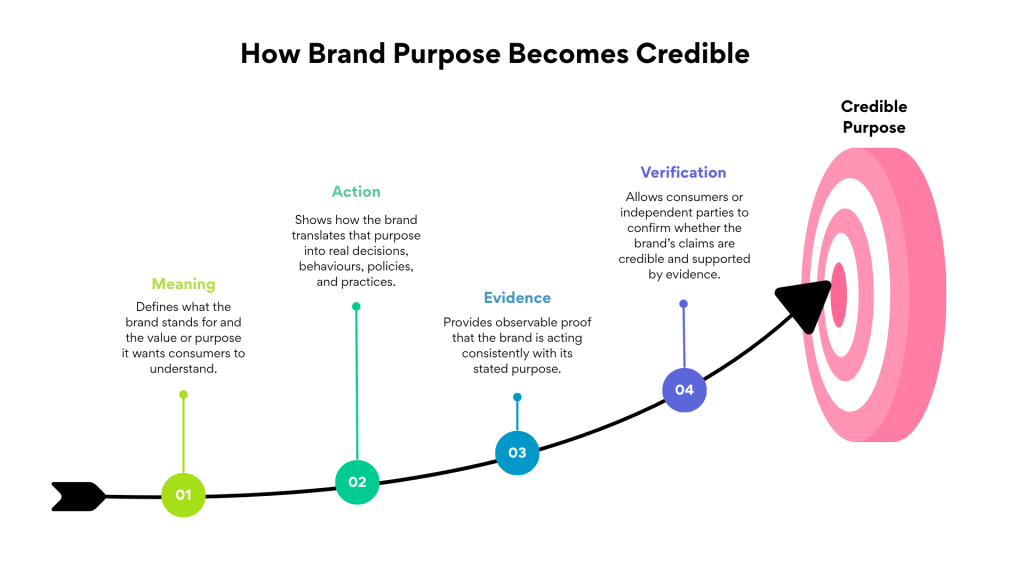
Meaning → Action → Evidence → Verification
Most consumers may never travel through every layer, and they do not need to. A shopper does not require a sustainability report every time they buy shampoo. Yet when sustainability becomes relevant to that consumer, deeper evidence needs to be accessible.
Recent work on sustainability communication reinforces the importance of providing meaningful information across multiple touchpoints. Dasmi et al. (2026), examining sustainable luxury fashion brands, show that omnichannel sustainability communication can contribute to consumer brand engagement, positive word of mouth, community, and helpfulness. Purpose therefore develops across an ecosystem of touchpoints, and activation can occur at different points within that ecosystem.
Identity introduces another layer. Purpose becomes especially powerful when an issue overlaps with the consumer’s understanding of self. The consumer is then evaluating the brand partly as an expression of personal values.
Recent purpose-driven research supports this connection. Pahari et al. (2026), studying sustainable luxury, found that perceived sustainability–luxury fit and brand ethicality can foster emotional responses such as brand attachment and pride, which subsequently influence behavioural outcomes. Henning and Nussbaum (2026) also report evidence connecting brand purpose with loyalty through brand distinctiveness. These studies suggest that purpose can contribute to differentiation while also supporting deeper psychological relationships with consumers.
Yet activation remains situational. A sustainability identity does not carry identical weight in every consumption context. A social cause is not constantly salient. A person’s values may remain relatively stable while their attention to those values fluctuates considerably. Brand-purpose influence therefore depends partly on the moment in which identity becomes relevant to choice.
This is why purpose should be treated carefully as a brand attribute. Price can be printed on a label. Weight can be measured. Technical performance can often be demonstrated. Purpose depends more heavily on interpretation, relevance, credibility, and context.
Purpose as a Reserve of Meaning
Purpose can therefore be understood as a reserve of meaning.
Brands accumulate this reserve through consistent action, culture, reputation, communication, transparency, and experience. Consumers may not consciously access that reserve during every transaction. Much of the time, it remains in the background as a general impression of what the organization represents.
The reserve becomes strategically valuable when circumstances make it relevant.
When uncertainty rises, consumers may draw on it. When trust is challenged, they may draw on it. When identity becomes relevant, they may draw on it. When a social issue becomes salient, they may draw on it. When competitors appear functionally similar, purpose may become an additional source of differentiation.
Purpose therefore has something resembling an option value. A company may invest in meaningful, credible behaviour during periods of low consumer attention because the accumulated meaning can become more valuable when circumstances change.
This perspective also reveals why purpose-washing creates significant strategic risk. Symbolic positioning can generate short-term benefits while scrutiny remains low, yet it also creates a hidden liability. The larger the difference between communicated purpose and organizational behaviour, the more vulnerable the brand becomes when activation occurs. Walter et al. (2024) show empirically that consumers respond negatively when purpose appears performative. Henning and Kirchgeorg (2026) similarly argue that purpose needs meaningful overlap with brand identity to maintain credibility.
When the Framework Breaks Down
The Activated Purpose framework, however, also has important boundary conditions.
Activation does not always lead to meaningful verification. Consumers may lack the time, knowledge, access, literacy, or motivation required to evaluate a company’s evidence. Some purpose claims are inherently difficult to verify from the outside. Many supply chains are highly complex, and even sophisticated consumers may have difficulty determining whether claims are accurate.
Deeper disclosure may also produce unintended consequences. Complex sustainability trade-offs, imperfect labour practices, or standard industry processes can appear troubling when encountered without sufficient context. Greater scrutiny can therefore generate confusion, information overload, or new grounds for skepticism. Montecchi et al. (2024) highlight the possibility that transparency itself can produce costs when consumers become overwhelmed or increasingly critical.
Category characteristics may also limit activation. In very low-involvement purchases, a triggering event may produce only a temporary shift in attention. In categories where consumers have few alternatives, even strong dissatisfaction with a brand’s purpose may have little behavioural effect. Likewise, if all major competitors share similar ethical shortcomings, activated scrutiny may alter attitudes without producing meaningful switching behaviour.
These limits are important because they prevent the framework from assuming that activated purpose always produces a predictable outcome. Activation increases the evaluative importance of purpose. The consequences depend on available evidence, consumer capability, competitive alternatives, issue relevance, and the structure of the category.
A Research Agenda for Activated Purpose
The framework also lends itself to empirical testing.
Activation could be operationalized as a measurable change in the importance consumers assign to brand purpose before and after a triggering event. Researchers could examine shifts in brand-related search behaviour, visits to purpose or sustainability webpages, review language, social sentiment, willingness to pay, brand trust, purchase intention, switching behaviour, or sales sensitivity following an event that increases issue salience.
Experimental research could also manipulate perceived risk, identity relevance, or exposure to external events and examine whether consumers subsequently assign greater weight to purpose-related information. Longitudinal research could track how the same consumers evaluate a brand before, during, and after a controversy or cultural event.
Evidence against the framework would include situations in which substantial increases in personal relevance, perceived risk, or issue salience produce no corresponding change in attention to, evaluation of, or behaviour toward the brand’s stated purpose. Such findings would help establish the boundaries of activation and clarify which conditions are necessary for purpose to become consequential.
The concept therefore opens a broader research agenda. Future work could examine whether activation differs by category, whether negative triggers produce stronger effects than positive ones, how long activation persists, whether repeated activation creates durable changes in brand meaning, and whether certain forms of transparency accelerate or dampen the process.
The traditional strategic question has consequently become insufficient. A brand may know what it stands for, but that does not mean consumers will care. The real strategic challenge is understanding when, why, and under what conditions purpose becomes meaningful to them.
That question creates a different kind of marketing conversation.
What personal concerns could activate our purpose? What perceived risks make consumers investigate us more carefully? Which aspects of identity connect people to what we stand for? What cultural events could suddenly make our behaviour relevant? At which touchpoints do consumers begin looking for answers? How easily can they move from our claims to our actions? If they continue investigating, what evidence will they find? How large is the distance between the meaning we communicate and the reality we can prove?
Purpose-driven branding therefore becomes the management of meaning before, during, and after activation. The central strategic issue is whether a brand’s purpose remains coherent, relevant, and defensible when circumstances cause consumers to place greater weight on it.
A purpose matters most when the consumer finally has a reason to test it.
References
Abratt, R., Quaye, E. S., & Kleyn, N. (2025). Conscientious corporate brands: The roles of organisational purpose, organisational culture, brand authenticity and corporate social responsibility. Journal of Brand Management, 32, 418–437. https://doi.org/10.1057/s41262-025-00392-1
Dasmi, C., Nechaeva, O., & Rovai, S. (2026). Linking sustainability to consumer brand engagement in omnichannel communication of luxury fashion brands. Journal of Consumer Marketing, 43(5), 733–751. https://doi.org/10.1108/JCM-11-2024-7378
Henning, E., & Kirchgeorg, M. (2026). Purpose-driven brand identity: Unveiling the link between brand purpose and brand identity. Journal of Product & Brand Management, 35(4), 532–547. https://doi.org/10.1108/JPBM-11-2024-5624
Henning, E., & Nussbaum, J. A. (2026). Brand purpose as an amplifier of brand loyalty? The mediating role of brand distinctiveness. Journal of Strategic Marketing, 298–315. https://doi.org/10.1080/0965254X.2026.2622975
Montecchi, M., Plangger, K., West, D., & de Ruyter, K. (2024). Perceived brand transparency: A conceptualization and measurement scale. Psychology & Marketing, 41, 2274–2297. https://doi.org/10.1002/mar.22048
Nascimento, J., & Loureiro, S. M. C. (2024). Purpose is the new branding: Understanding conscientious purpose-driven marketing and its impact on brand outcomes. Journal of Product & Brand Management, 33(6), 761–775.
Pahari, S., Patra, M., Menghani, K., & Thaichon, P. (2026). Sustainable luxury: Understanding consumer responses to purpose-driven brand strategies. Journal of Consumer Behaviour, 1–22. https://doi.org/10.1002/cb.70178
Sansome, K., Conduit, J., & Wilkie, D. (2025). Consumers demand transparency… but do they actually engage? Exploring motives and interactions with brand transparency information. Journal of Business Research, 194, 115386. https://doi.org/10.1016/j.jbusres.2025.115386
Sansome, K., Wilkie, D., & Conduit, J. (2024). Beyond information availability: Specifying the dimensions of consumer perceived brand transparency. Journal of Business Research, 170, 114358. https://doi.org/10.1016/j.jbusres.2023.114358
Walter, N., Föhl, U., Sander, F., & Nies, A. (2024). Act as you preach! Authentic brand purpose versus “woke washing’s” impact on brand credibility: The moderating role of cause involvement and consumer skepticism. Journal of Business Research, 184, 114868. https://doi.org/10.1016/j.jbusres.2024.114868


Leave a comment