
If a brand does not tell people what it stands for, it is a cabbage. A brand publishes a purpose, formulates a positioning statement, defines a personality, and spends millions communicating all three. Yet consumers rarely encounter a brand in the abstract. They encounter a package on a shelf, a photograph on Instagram, a sentence in an advertisement, the movement of an interface, the sound accompanying an interaction, the architecture of a store, or the particular way an employee speaks to them. Before consumers interpret the strategy behind a brand, they encounter its style.
This suggests a deceptively simple proposition: styles make brands. Here, style should not be understood as decoration or as the aesthetic layer applied after the serious strategic work has been completed. Style is the recurring manner in which a brand makes itself perceptible. Color, typography, shape, photography, language, sound, motion, packaging, product design, spatial design, and patterns of interaction can all belong to it. When these elements repeatedly express a recognizable logic, they begin to function together as a system. Consumers learn that system, and eventually even a fragment can be enough to reveal the brand. McDonald’s Golden Arches, for example, can identify the brand without the word “McDonald’s” appearing beside them.
That process matters because brand recognition depends on associations stored in consumers’ memory. Research into brand identity elements shows that logos, colors, taglines, characters, music, sounds, and other distinctive elements can become cues through which consumers identify a brand (Brus et al., 2026). Consumers therefore do not necessarily need the complete identity every time they encounter it. Once particular cues have developed sufficiently strong and unique associations, fragments of the identity can retrieve the larger brand.
This is where style becomes strategically powerful. A logo can identify a brand, while a sufficiently developed style allows identification to escape the logo. A photograph can feel like the brand, a sentence can sound like the brand, a product can look like the brand from across a room, and a few musical notes can evoke it before its name is spoken. The strongest brand styles therefore operate less like collections of assets and more like grammars: they establish principles that allow many different expressions to remain recognizably related.
Assets vs. Grammar
Traditional discussions of brand identity often concentrate on assets such as the logo, typeface, palette, tagline, packaging system, characters, shapes, and sonic cues. These assets matter enormously. Brus et al. (2026), for example, examined 405 brand identity elements used by 50 brands across five product categories and found substantial differences in how strongly and uniquely individual elements cue brands in consumers’ minds.
Yet thinking only in terms of assets understates what style can accomplish. Consider language. A brand can own a tagline, but its verbal style extends far beyond that tagline. Sentence length, vocabulary, humor, punctuation, confidence, directness, metaphor, and even what the brand habitually refuses to say can form a recognizable verbal pattern. Research discussed by Stanford on the memorability of language shows that particular linguistic characteristics influence what people retain. Concrete words tend to be more memorable than abstract ones; emotional language, particularly language involving loss or social connection, can stand out; and even informal expressions such as “oops” can increase recall (Stanford University, 2025). A verbal style can therefore be designed around more than subjective notions of tone. Its vocabulary and structure can influence memorability.
The same principle operates visually. A brand’s style is not reducible to the statement that “our color is blue.” It may involve particular relationships among color, whitespace, scale, composition, photography, materials, iconography, and movement. The relationship among these elements can be as important as the elements themselves. Imagine hearing four notes of a familiar melody. None of those notes individually constitutes the composition; their relationship creates the recognizable form. Brand style can work similarly. A particular shade, typeface, photographic angle, phrase, or sound may have limited meaning alone, while repeated relationships among these elements create a recognizable pattern.
This allows us to distinguish between brand assets and brand grammar. Assets are the vocabulary available to a brand while grammar governs how that vocabulary is combined. A company can possess excellent assets and still have a weak style. If its photography changes radically from campaign to campaign, its language oscillates between corporate formality and internet slang, its digital experience follows an unrelated aesthetic, and its packaging adopts whatever visual trend happens to be popular, the consumer receives fragments without a stable grammar. The brand continues speaking, but its accent keeps changing.
Distinctiveness Lives in Memory
The strategic value of style becomes clearer when branding is considered as a problem of recognition. Consumers live in environments saturated with competing stimuli, so every encounter with a brand asks something of attention and memory. A recognizable style reduces the amount of information required for a consumer to determine who is communicating.
Brus et al. (2026) found an especially important discrepancy between marketers’ assumptions and consumers’ actual associations. Marketers typically overestimated the fame of brand elements while underestimating their uniqueness. Managerial familiarity with an identity was therefore not a reliable substitute for measuring what consumers actually associated with the brand. The implication is significant because a style does not become distinctive simply because its designers or managers believe it is distinctive. Distinctiveness exists in consumer memory.
That claim creates an obvious managerial question: if distinctiveness exists in memory, how should it be measured? The work of the Ehrenberg-Bass Institute provides a practical answer. Its Distinctive Asset Grid assesses identity elements according to two dimensions: fame, which concerns how strongly an element evokes the brand among consumers, and uniqueness, which concerns whether the element evokes that brand rather than competitors (Ehrenberg-Bass Institute, n.d.). An element can therefore be visually striking without functioning as a strong distinctive asset. If consumers see it but do not connect it with the brand, it has low fame; if they associate it equally with several competitors, it has low uniqueness.
This turns style from an internal creative judgment into something that can be investigated empirically. A company can remove its name from a color, shape, character, package, sound, tagline, photograph, or other cue and test what consumers retrieve from memory. The important question is not whether managers like the asset, whether the design team considers it original, or whether it performed well in a presentation. The important question is what the cue has actually come to mean in the market.
This also explains why repetition matters. When consumers repeatedly encounter related colors, compositions, sounds, phrases, shapes, or interactions, those elements have opportunities to become associated with the same source. Over time, repeated style can generate familiarity, familiarity can support recognition, and recognition can strengthen associations. Style can therefore become a form of memory infrastructure, connecting otherwise fragmented encounters with the same brand.
The same logic explains why redesigns can be dangerous when they remove cues that consumers have already learned. Tropicana provides one of the clearest examples. In 2009, the company introduced redesigned packaging for its Pure Premium orange juice. The familiar orange pierced by a straw was removed and other elements of the package changed substantially. Research by Lee et al. (2010) found that sales of Tropicana Pure Premium fell approximately 20% during the period following the redesign and estimated the economic cost of the packaging change at roughly $27 million before the company returned to its earlier design.
The lesson is larger than Tropicana. Managers, designers, and agencies encounter their own brand assets far more frequently than ordinary consumers do, so internal boredom may arrive much earlier than external familiarity. What feels exhausted inside an organization may only recently have become recognizable outside it. Changing established cues because insiders are tired of seeing them can destroy memory structures that consumers have only begun to learn.
The Uniqueness Trade-Off
Protecting recognition does not mean making brands visually conservative, nor does distinctiveness mean maximizing unusualness. Feng et al. (2025) used machine learning to assess visual uniqueness in 481,747 Airbnb property images and then connected the measure with actual demand data. Their results revealed an inverted U-shaped relationship: greater visual uniqueness could improve outcomes to a point, after which additional uniqueness became less advantageous.
This exposes a fundamental tension in brand style. A brand must be familiar enough to be understood while remaining distinctive enough to be identified. Imagine two hotel advertisements. The first uses the same white bedding, wide-angle room photography, neutral lighting, and predictable composition as hundreds of competitors. It communicates “hotel” efficiently but provides little reason to associate the image with one particular brand. The second violates category conventions so aggressively that viewers struggle to understand what is being offered. It may achieve difference while sacrificing comprehension.
Effective style negotiates the territory between those extremes because difference and distinctiveness are not synonymous. Difference merely requires deviation. Brand distinctiveness requires deviation that remains identifiable, interpretable, and capable of becoming associated with a particular source. A strong style therefore helps consumers understand both what kind of offering they are encountering and which particular brand is speaking.
The word style is also often interpreted too narrowly as visual design. Brands can be heard as well as seen, and their style can emerge through voices, music, product sounds, interface sounds, rhythm, and recurring soundscapes. Brands can move in characteristic ways through animation, transitions, scrolling behavior, haptic responses, and digital microinteractions. They can also behave stylistically. How a company welcomes, explains, responds, apologizes, serves, and solves problems can become as characteristic as its typography.
Style therefore cannot be confined to the marketing communications department. Product designers, UX teams, architects, copywriters, packaging designers, service employees, composers, photographers, and marketers all participate in producing it. The power comes from relationships among these expressions. When they reinforce one another, the consumer encounters a coherent world. When they contradict one another, the brand begins to fragment.
Recognition is only the first achievement of that coherence. Once a stylistic pattern becomes associated with a brand, it can begin to carry meaning and eventually create expectations. A minimalist interface may become associated with simplicity. A particular photographic treatment may suggest intimacy. Dense technical language may communicate expertise to one audience and distance to another. Materials can imply durability or delicacy, while motion can feel energetic or restrained.
This matters because brands frequently try to persuade consumers by stating attributes such as innovative, human, premium, rebellious, sophisticated, or simple. Style offers another route: it can enact those attributes. A brand claiming simplicity while presenting a chaotic interface creates contradiction. A brand claiming warmth while communicating in cold bureaucratic language does the same. Positioning tells the organization what it wants to mean; style helps make that meaning perceptible.
Apple provides a useful illustration of this principle because its style demonstrates both continuity and adaptation. Its products, interfaces, typography, materials, advertising, retail environments, and operating systems have changed considerably over time, yet the company repeatedly attempts to establish relationships among them. When Apple introduced Liquid Glass in 2025, it described the system as a design language extending across iOS, iPadOS, macOS, watchOS, and tvOS while preserving qualities particular to the individual platforms (Apple, 2025). The strategic significance lies beyond the translucent visual treatment itself. The system illustrates an attempt to establish family resemblance across different experiences without requiring those experiences to become identical.
This reveals an important principle of style: consistency does not require duplication. A grammar permits variation. English sentences can differ enormously while remaining recognizably English because they share underlying structures. Strong brand systems can behave similarly. New products, campaigns, interfaces, packages, or environments may vary while preserving sufficient structural relationships to remain recognizable.
The AI Convergence Problem
Generative AI introduces a new complication into this system because it creates a quieter form of stylistic convergence. Historically, one obvious threat to distinctive style was imitation: competitors could observe successful colors, layouts, language, interfaces, or campaign ideas and reproduce them. Brands no longer need to imitate one another deliberately to begin sounding alike. They can arrive at similar expressions by relying on similar models, similar prompts, and similar instructions about what constitutes “good” communication.
Imagine five brands removing their names and logos from five social-media captions. If consumers can still identify the speaker, verbal style is performing brand work. Now imagine that all five organizations routinely ask a general-purpose language model to make their content “professional, engaging, concise, warm, and clear.” Each individual result may improve. Awkward sentences disappear, grammar improves, unnecessary words are removed, and the copy becomes smoother. Yet the brands may gradually acquire similar sentence rhythms, transitions, vocabulary, rhetorical structures, and forms of politeness. Each output can be competent while the collection becomes increasingly indistinguishable.
Recent evidence gives this concern considerable weight. Agarwal et al. (2025) conducted a controlled experiment involving 118 participants from India and the United States who completed culturally grounded writing tasks with and without AI suggestions. AI assistance made the writing of Indian and American participants more similar and shifted Indian participants toward Western writing styles. Importantly, the effect concerned not only what people wrote but how they wrote it. The technology influenced stylistic expression itself.
For brands, the implication extends beyond culture because distinctiveness is relational. A piece of communication is not distinctive merely because it is well written. It becomes distinctive when its patterns can be differentiated from the patterns surrounding it. Generative AI therefore creates a paradox: it can improve individual communications while weakening collective differentiation. A caption can become clearer, a product description smoother, an email more professional, and interface microcopy more concise. Yet if thousands of organizations simultaneously optimize communication toward similar definitions of clarity, friendliness, concision, confidence, and professionalism, individual improvement can generate market-level sameness.
Research on workplace creativity also suggests that the solution is unlikely to be passive reliance on the technology. Sun et al. (2025) conducted a field experiment involving 250 employees and found that generative AI enhanced creativity particularly among employees with strong metacognitive strategies: people who actively planned, monitored their thinking, identified gaps, and revised their approaches. The implication for branding is important. AI can expand creative capacity, but organizations still need a system for directing that capacity.
Brand grammar can provide part of that system. A weak approach gives a generative model a topic and asks it to produce something polished. A stronger approach defines characteristic vocabulary, sentence structures, rhythm, degree of humor, emotional range, preferred metaphors, prohibited expressions, visual principles, and examples of what does and does not belong to the brand. AI is then no longer being asked to invent the brand’s style. It is being asked to operate within an established one.
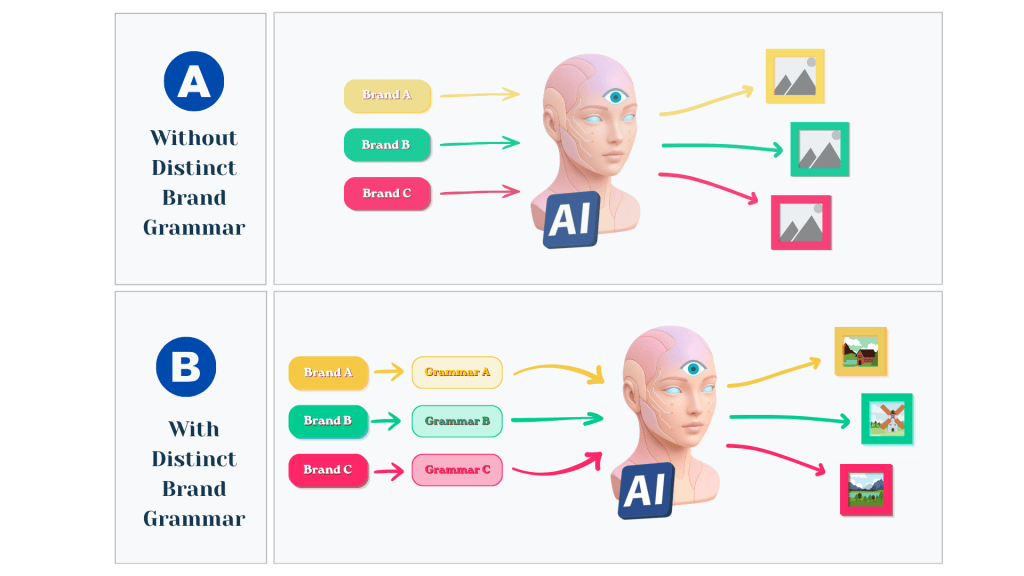
Note. Conceptualized by the author.
The distinction matters because general-purpose models inevitably bring patterns of their own. When a company asks AI to make something “premium,” “engaging,” or “human,” the model must infer what those concepts look or sound like from patterns it has learned. Those patterns are not necessarily the patterns uniquely associated with the organization using it. The strategic question therefore cannot stop at whether AI-generated content is good. Managers increasingly need to ask whether it is recognizably ours.
Stanford research on language adds another useful warning. Ada Aka’s work suggests that conversational and engaging LLM communication can come with a trade-off: audiences may enjoy the interaction while remembering precise information less effectively (Stanford University, 2025). This reinforces a broader principle. There is no universal “best” style. A style that works for entertainment may perform differently when the objective is technical recall, trust, luxury, authority, or reassurance. Brands should therefore resist outsourcing stylistic decisions to generic instructions about making communication more engaging.
The Cornell findings also reveal an important cultural boundary condition. A brand grammar developed in one market cannot automatically be treated as culturally neutral. Agarwal et al. (2025) showed that AI assistance could pull culturally specific writing toward Western norms and reduce cultural nuance. Global brands therefore face a challenge beyond consistency. If they impose one linguistic and aesthetic expression everywhere, they may preserve formal uniformity while weakening cultural relevance.
A global brand consequently needs a grammar, not a single accent. Its underlying principles can remain recognizable while their expression adapts to language, culture, and context. The objective is neither total localization, in which the brand becomes unrecognizable across markets, nor total standardization, in which local expression is flattened. The objective is coherent variation.
Coherent Variation
This brings us to one of the central paradoxes of style. Consumers cannot learn a style without repetition, yet endless literal repetition can become predictable and limit a brand’s capacity to evolve. Style therefore resembles a musical theme more than a stamp. A composer can transform a theme by changing its orchestration, tempo, register, harmony, or dynamics without destroying its identity. Variation can even make the underlying structure more apparent because listeners gradually learn which characteristics can change and which relationships preserve identity.
Brands can operate similarly. Some elements should remain stable, others can flex, some should evolve slowly, and others can respond more quickly to cultural change. The strategic challenge is identifying which elements carry the greatest recognition and meaning rather than subjecting every element to the same level of consistency.
Generative AI makes this distinction particularly important because enormous variation is now technically easy to produce. Yet the ability to generate endless alternatives does not mean endless alternatives are strategically desirable. A brand that continually explores every available style may eventually teach consumers that it has no style at all. Freshness has little strategic value if it destroys accumulated recognition, while consistency becomes equally limiting if it prevents adaptation. The objective is recognizable evolution.
There is also an understandable objection to the proposition that styles make brands: a beautiful style cannot rescue a bad product. This is correct, and it strengthens the argument rather than undermining it because style creates expectations that operations must eventually fulfill. If a restaurant’s style communicates intimacy, the service experience must support intimacy. If a technology brand’s style communicates effortless simplicity, unnecessary product complexity becomes particularly damaging because it violates an expectation the brand itself helped create. If packaging communicates environmental responsibility while the company’s behavior contradicts that impression, style can eventually become evidence against the brand rather than for it.
Style and substance therefore interact. Repeated stylistic cues establish expectations, while repeated experiences confirm, modify, or contradict them.
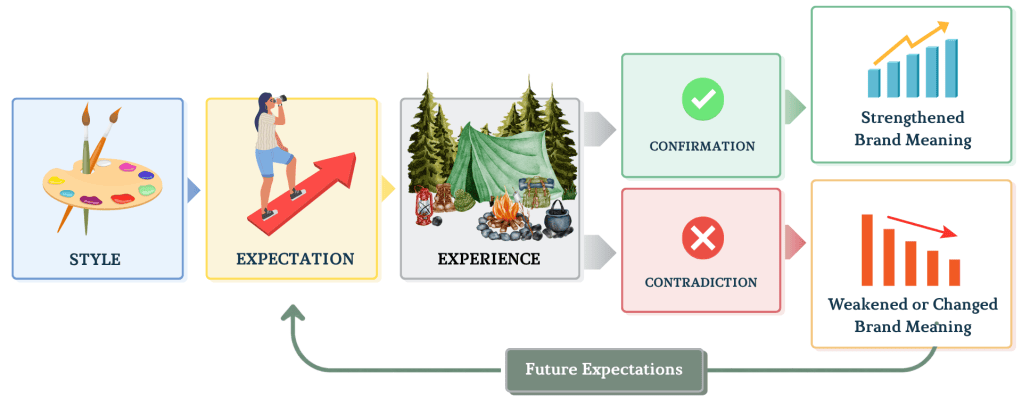
Note. Conceptualized by the author.
This also explains why copying another successful brand’s style rarely transfers the meaning attached to it. A minimalist package does not automatically create Apple’s associations. A particular shade of blue does not automatically create trust. A witty social-media voice does not automatically create cultural relevance. Visible expressions acquire meaning through repeated association with products, experiences, behaviors, history, and expectations. Style accumulates meaning because the brand repeatedly inhabits it.
Style as Constraint
One of the least appreciated functions of style is that it tells a brand what not to do. Once a brand develops a sufficiently coherent grammar, countless creative possibilities become inappropriate even when they are individually attractive. A photograph may be beautiful but wrong for the brand. A joke may be funny but sound unlike the brand. A fashionable typeface may be appealing but weaken recognition. A viral social-media format may generate attention while making the organization behave like everyone else.
A mature style is therefore partly a system of constraints. Constraints can sound undesirable in creative work, yet they are precisely what makes recognizable creativity possible. If every decision remains available every time, each campaign effectively begins from zero. When a grammar exists, creators work inside recognizable territory and search for novelty within it. Strong brand systems give creative freedom boundaries, changing the question from “What could we possibly make?” to “What is a new expression that could unmistakably belong to us?”
Generative AI makes this question even more consequential. A system capable of producing hundreds of alternatives in seconds dramatically increases the number of possible expressions available to a brand. Brand grammar becomes the mechanism for rejecting possibilities that are attractive, competent, or fashionable but stylistically foreign. As generative possibility expands, the ability to constrain it strategically becomes more valuable.
The deepest strategic value of style is therefore not beauty. It is coherence through recognition. A brand must survive fragmentation because consumers encounter only pieces of it: an advertisement today, packaging next week, an interface months later, a customer-service conversation, a sound, a photograph, or a product in someone else’s hand. Consumers rarely see the strategy deck or brand guidelines explaining how these pieces are supposed to connect. They simply encounter the pieces, and style makes those fragments feel related.
When those relationships become sufficiently strong, the organization no longer needs to introduce itself completely every time. Consumers can begin recognizing the speaker before reading the signature. This becomes even more consequential in an environment where polished communication is becoming cheaper and easier to produce. If technical competence becomes widely available, recognizable particularity becomes more valuable. Many competitors can produce content that is attractive, professional, clear, and technically accomplished, increasingly using the same underlying technologies. The harder question is whether the expression could have come from anyone else.
A color can carry associations accumulated through years of exposure. A curve can recall products and experiences. A particular sentence structure can retrieve a familiar personality. A sound can anticipate an interaction. A movement can feel characteristic of the company that designed it. Individually, these may appear trivial; collectively and repeatedly, they become retrieval cues for a much larger network of memories, experiences, meanings, and expectations.
This leads to a useful test for brand managers. Remove the company name, the logo, and the slogan. Then look at the photograph, read the sentence, touch the package, hear the sound, navigate the interface, or enter the space and ask whether you can still tell whose world you have entered. When the answer is consistently yes, style has stopped being decoration.
It has become brand.
References
Agarwal, D., Naaman, M., & Vashistha, A. (2025). AI suggestions homogenize writing toward Western styles and diminish cultural nuances. Proceedings of the 2025 CHI Conference on Human Factors in Computing Systems, Article 1117, 1–21. https://doi.org/10.1145/3706598.3713564
Apple. (2025, June 9). Apple introduces a delightful and elegant new software design. Apple Newsroom. https://www.apple.com/ca/newsroom/2025/06/apple-introduces-a-delightful-and-elegant-new-software-design/
Brus, R., Hartnett, N., Faulkner, M., & Driesener, C. (2026). Assessing branding strength: Comparing marketer judgement and consumer data for brand identity elements. Journal of Brand Management, 33(1), 1–17. https://doi.org/10.1057/s41262-025-00395-y
Ehrenberg-Bass Institute for Marketing Science. (n.d.). Brands of distinction. University of South Australia.
Feng, X., Li, C. X., & Zhang, S. (2025). Visual uniqueness in peer-to-peer marketplaces: Machine learning model development, validation, and application. Journal of Consumer Research, 52(4), 800–825. https://doi.org/10.1093/jcr/ucaf021
Lee, J.-Y., Gao, Z., & Brown, M. G. (2010). A study of the impact of package changes on orange juice demand. Journal of Retailing and Consumer Services, 17(6), 487–491. https://doi.org/10.1016/j.jretconser.2010.08.003
Stanford University. (2025, March). Research examines what makes words memorable and how language impacts decision-making. Stanford Report.
Sun, S., Li, Z. A., Foo, M.-D., Zhou, J., & Lu, J. G. (2025). How and for whom using generative AI affects creativity: A field experiment. Journal of Applied Psychology, 110(12), 1561–1573. https://doi.org/10.1037/apl0001296


Leave a comment