By Damian Rezaee
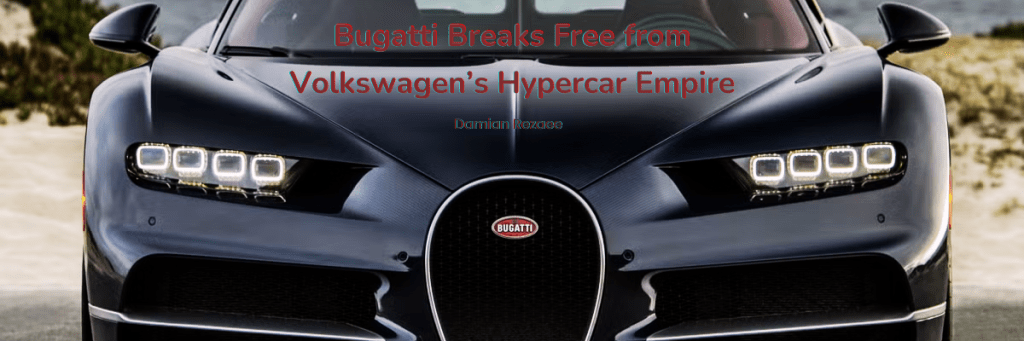
On April 24, 2026, transaction agreements were signed that formally ended one of the most consequential relationships in modern automotive history. Porsche AG agreed to sell its 45% stake in Bugatti Rimac and its 20.6% stake in the Rimac Group to a consortium led by New York-based investment firm HOF Capital (Porsche AG, 2026). With that single transaction, Volkswagen Group’s involvement with Bugatti, which began with the brand’s revival in 1998, came to a definitive close (Autoblog, 2026a). The separation was not the result of a single strategic misstep. It was the culmination of compounding financial pressures, a failed electrification bet, and the structural reality that Bugatti had always been an uncomfortable fit inside a mass-market conglomerate.
This analysis examines the historical roots of the relationship, the specific forces that precipitated the break, the mechanics of the new ownership structure, and the strategic implications for all parties involved.
The importance of this separation goes beyond the ownership transfer itself. Bugatti was never just another brand in Volkswagen Group’s portfolio. It was a symbolic asset: a brand that proved Volkswagen could operate at the very top of engineering prestige. For nearly three decades, Bugatti gave VW a halo that no mass-market brand could generate on its own. The sale therefore signals more than financial discipline. It marks the end of a corporate philosophy in which technical ambition, even when commercially irrational, could be justified as a statement of group capability. In that sense, the transaction is both an automotive event and a strategic confession: the industry has moved into a phase where even prestige must defend its capital allocation logic.
Part I: The VW Era in Context (1998–2021)
The modern Bugatti was a product of Ferdinand Piech’s ambition. As CEO of Volkswagen Group, Piech spent the 1990s assembling a portfolio of prestige automotive brands, acquiring Lamborghini in 1998, Bentley the same year, and formally incorporating Bugatti Automobiles S.A.S. on December 22, 1998 (CarBuzz, 2026). The promise he made to the market was audacious: a production car producing 1,000 horsepower with a top speed exceeding 250 mph before the end of the decade. The 2005 Veyron 16.4, named after Bugatti’s 1930s test driver Pierre Veyron, delivered on that promise and redefined what a hypercar could be (CarBuzz, 2026).
Under VW stewardship, Bugatti produced icons that became cultural reference points: the Veyron and the Chiron. Both were engineering monuments subsidized by the scale of a conglomerate with deep parts-sharing ecosystems. As Autoblog (2026a) observed, components from the Chiron Super Sport were later found to be shared with more mainstream Audi and Volkswagen models, illustrating just how embedded Bugatti had become within the VW supply architecture.
Yet by 2020, VW Group CEO Herbert Diess characterized Bugatti as “ballast,” an unprofitable brand that had moved fewer than 700 vehicles since 2005 (Autoblog, 2026a). The conglomerate began exploring options for divestiture, initiating talks with Croatian electric vehicle company Rimac Automobili. In July 2021, the solution materialized: Bugatti Automobiles would merge with the sports car operations of Rimac to form Bugatti Rimac, a joint venture in which Rimac Group held a 55% majority stake and Porsche AG retained 45% (Porsche AG, 2026).
The structure was designed to give Bugatti a dedicated home with electrification expertise while allowing Porsche to maintain a stake in the prestige brand it had long helped underwrite. For a time, it worked. Bugatti Rimac’s first major jointly developed product, the Tourbillon, debuted in 2024 with a naturally aspirated 8.3-liter V16 engine co-developed with UK firm Cosworth, paired with three electric motors producing a combined 1,775 horsepower and officially retiring the legendary W16 (Rimac Newsroom, 2025).
The VW era should be understood as a period of brand resurrection through industrial excess. Volkswagen did not revive Bugatti because Bugatti could become a conventional profit center. It revived Bugatti because the brand could dramatize what VW engineering was capable of at the absolute limit. The Veyron and Chiron functioned as brand artifacts as much as products. They created proof of technical supremacy, cultural recognition, and luxury legitimacy for the wider group. This is why the later description of Bugatti as “ballast” is so strategically revealing. The same qualities that once made Bugatti valuable as a halo asset, extreme cost, low volume, and engineering irrationality, eventually made it hard to justify in a financial environment demanding efficiency, electrification discipline, and cleaner capital priorities.
There is also a portfolio-management lesson here. Prestige brands can lift the perceived capability of a parent company, but only when the parent company has enough financial strength to absorb the prestige brand’s economic irrationality. When the parent company’s core businesses come under pressure, the halo becomes vulnerable. Bugatti did not change first. Volkswagen’s tolerance for Bugatti changed because the wider automotive context changed around it.
Part II: Why the Separation Happened
2.1 Porsche’s Financial Collapse
The proximate cause of the divestiture was an unprecedented deterioration in Porsche AG’s financial position. In its 2025 fiscal year, the company reported group operating profit of just EUR 413 million, down from EUR 5.64 billion the year prior, a collapse of 92.7%. The automotive division alone saw operating profit fall 98.3%, from EUR 5.3 billion to just EUR 90 million (Porsche AG, 2026a).
The causes were simultaneous and mutually reinforcing. Porsche booked extraordinary charges totalling approximately EUR 3.9 billion in 2025: EUR 2.4 billion in product strategy realignment and company rescaling costs, EUR 700 million from battery-related write-downs tied to paused EV programs, and EUR 700 million in costs directly attributable to U.S. import tariffs imposed by the Trump administration (Porsche AG, 2026a). Overall deliveries declined 10.1% to 279,449 vehicles, and revenue fell to EUR 36.27 billion from EUR 40.08 billion (Porsche AG, 2026a).
The significance of Porsche’s collapse extends beyond the company itself. As Euronews (2026) reported, Porsche AG and Audi had historically been the two brands that subsidized the rest of Volkswagen Group’s sprawling, lower-margin portfolio. When Porsche’s automotive margin shrank from 14.5% to 0.3% in a single year, VW Group lost its most critical internal profit engine almost overnight. This systemic pressure made holding discretionary, prestige-adjacent assets like Bugatti Rimac untenable.
Porsche’s collapse matters because it converts the Bugatti sale from a luxury-brand story into a balance-sheet story. When a company with Porsche’s historical margin strength suddenly experiences a margin compression of this scale, management attention shifts from optionality to survival discipline. Under stable conditions, a 45% stake in Bugatti Rimac could be framed as strategic exposure to ultra-luxury electrification. Under financial stress, that same stake becomes trapped capital. The asset did not necessarily become less prestigious. It became less defensible.
This is also a warning about internal cross-subsidization. When premium brands subsidize a broader group, they become systemically important. The parent company may appear diversified, but its financial health can still depend heavily on a few high-margin contributors. Porsche’s sudden weakness exposed that vulnerability. Once the internal profit engine faltered, discretionary holdings had to be reclassified. Bugatti Rimac moved from a strategic prestige asset to a liquidity source.
2.2 The China Problem
The Chinese market collapse was among the most structurally damaging elements of Porsche’s crisis. Deliveries in China dropped 26% in 2025, as domestic Chinese manufacturers disrupted the premium EV segment with vehicles that matched the performance of European products at significantly lower price points (International Finance, 2025). As International Finance (2025) documented, Xiaomi’s SU7 model offered performance comparable to the Taycan at roughly half the cost, while Chinese consumers increasingly prioritized software integration and AI-enabled connectivity features that European infotainment systems failed to deliver.
China had been Porsche’s most important growth market, at one point accounting for 93,000 annual deliveries. By 2025, that figure had declined toward 40,000, representing a contraction that no amount of internal restructuring could quickly offset (International Finance, 2025). The loss of that revenue base meant that holding non-core stakes, including the 45% interest in Bugatti Rimac, became a capital efficiency liability.
The China problem is not simply a regional sales problem. It is a shift in the definition of premium value. For decades, European luxury automakers benefited from heritage, craftsmanship, performance, and badge status. In China’s EV market, those signals are increasingly being challenged by software fluency, interface quality, price-performance ratios, and domestic technological confidence. This creates a strategic crisis for legacy premium brands: they cannot rely only on engineering prestige when consumers are redefining desirability through digital experience.
Porsche’s China decline also shows how vulnerable luxury brands become when a growth market turns into a competitive battlefield. China once amplified Porsche’s global growth story. By 2025, it had become a source of margin pressure, pricing pressure, and brand-positioning pressure. That reversal helps explain why Porsche could no longer afford to maintain exposure to assets that did not directly stabilize its core business.
2.3 The Failed EV Bet
Porsche had positioned itself as the flagship electrification brand within Volkswagen Group. The Taycan was supposed to justify VW’s enormous investment in EV infrastructure. That thesis did not survive contact with market reality. Taycan deliveries fell 22% in 2025, and demand for high-end electric performance vehicles grew more slowly than projected across most markets (Euronews, 2026). The resulting reversal carried a financial cost of approximately EUR 2.7 billion in write-downs tied to halted or deferred EV programs, including the delayed electric versions of the 718 Boxster and Cayman, now pushed to 2027, and the Porsche K1 flagship SUV, deferred to around 2029 (Autoblog, 2026b).
The irony is significant. Porsche entered the Bugatti Rimac joint venture in part to position itself at the forefront of electrified hypercars. It exits that venture precisely because the financial consequences of over-investing in electrification left it unable to maintain non-core equity positions.
The failed EV bet exposes the danger of confusing technological inevitability with market timing. Electrification may still define the long-term future of performance vehicles, but Porsche’s problem was not only direction. It was pacing, capital intensity, and consumer readiness. When companies build strategy around a future that arrives unevenly, they can be correct in principle and still punished financially in the short term. Porsche’s retreat from Bugatti Rimac is therefore less a rejection of electrification itself and more a rejection of an overextended electrification timetable.
The Bugatti Rimac connection makes this even more interesting because Rimac represents one of the strongest credibility sources in electric performance engineering. Porsche did not exit because Rimac lacked capability. It exited because Porsche’s own capital constraints made long-term optionality harder to hold. That distinction matters. Strategic fit can be strong while financial timing is wrong.
2.4 Structural Misalignment from the Start
Beyond the immediate financial crisis, a deeper structural reality made the eventual separation logical. Bugatti was never a natural fit within a volume-driven conglomerate. Its entire identity rests on extreme exclusivity, bespoke engineering, and an absence of economies of scale. The Tourbillon, priced at approximately EUR 3.8 million per unit with production limited to 250 examples, generates revenue on a basis entirely incompatible with the metrics by which VW Group evaluates divisional performance (Autoblog, 2026c).
Mate Rimac, CEO of Bugatti Rimac, had also made clear his desire for greater autonomous control over the brand. As Spear’s (2025) reported, Rimac had developed a ten-year vision for Bugatti centered on the Tourbillon and the engineering philosophy it embodied. Operating within a joint venture that required consensus with a financially distressed Porsche complicated his ability to execute that vision at the pace he wanted.
Structural misalignment is the deepest cause of the separation because it existed even before the financial crisis. Bugatti’s brand logic is anti-scale. Volkswagen’s corporate logic is scale. Bugatti’s value increases when production is limited, difficult, slow, and symbolic. Volkswagen’s operating model depends on shared platforms, purchasing power, production efficiency, and capital productivity. That tension can be managed when profits are abundant, but it becomes harder to justify when the group is under pressure.
From a brand-management perspective, Bugatti is valuable because it resists normal managerial logic. Its scarcity is part of the product. Its impracticality is part of the story. Its engineering excess is part of the brand memory structure. A mass-market conglomerate can own such a brand, but ownership requires philosophical patience. Once leadership begins evaluating it primarily through conventional financial-performance logic, the brand inevitably looks inefficient.
Part III: The New Ownership Structure
3.1 Transaction Details
The transaction agreements were signed on April 24, 2026. Porsche AG divested its entire 45% stake in Bugatti Rimac and its 20.6% stake in Rimac Group to a consortium led by HOF Capital, a New York-based investment firm (Porsche AG, 2026b). The consortium includes BlueFive Capital, an Abu Dhabi-based firm that serves as its largest single investor, alongside a group of institutional investors from the United States and Europe (Porsche AG, 2026b). Financial terms were not disclosed, though Reuters estimated Bugatti Rimac’s total valuation at over $1 billion, suggesting Porsche may have realized approximately $500 million from the Bugatti Rimac stake alone (CarBuzz, 2026).
Following regulatory clearance, which both parties expect to occur before the end of 2026, Rimac Group will take formal control of Bugatti Rimac. HOF Capital will also become the largest shareholder in Rimac Group alongside Mate Rimac himself (Porsche AG, 2026b).
The structure matters because it shifts Bugatti from conglomerate ownership to a more concentrated, specialist-led capital environment. Porsche’s exit removes an industrial shareholder with competing priorities and replaces it with financial investors whose return logic will likely depend on brand equity, controlled scarcity, and technology commercialization. That can be positive if the investors understand Bugatti’s economics. It can be dangerous if they pressure the brand to behave like a scalable growth company.
The estimated valuation also suggests that Bugatti Rimac is being treated as more than a hypercar producer. The value likely reflects a combination of brand equity, technology capability, and future licensing or supplier potential through Rimac Technology. In other words, the deal is not only about selling rare cars. It is about owning a platform where ultra-luxury branding and advanced powertrain engineering reinforce each other.
3.2 The New Capital Partners
HOF Capital was co-founded by Hisham Elhaddad, a member of Egypt’s Sawiris dynasty, one of the most prominent business families in the Arab world (Carscoops, 2025). At the time the deal was announced, HOF Capital Managing Partner Elhaddad stated the firm viewed Bugatti as a brand where “heritage and innovation coexist at the highest level” and framed their involvement as shaping the brand’s “next chapter” through “disciplined growth” alongside Rimac (Bugatti Newsroom, 2026).
BlueFive Capital, founded by Hazem Ben-Gacem and headquartered in Abu Dhabi, characterized the acquisition as more than a financial transaction, citing a commitment to honoring Bugatti’s legacy “for generations to come” (Bugatti Newsroom, 2026). The Abu Dhabi-linked capital base is notable: Gulf sovereign wealth ecosystems have demonstrated sustained interest in ultra-luxury automotive assets, and their long investment horizons are well-suited to a brand that sells fewer than 100 vehicles per year.
The language used by the new investors is important because Bugatti’s future depends heavily on whether capital behaves as a steward or an extractor. Words such as “heritage,” “innovation,” and “disciplined growth” are strategically safe, but the real test will be whether ownership protects scarcity when expansion opportunities appear. Ultra-luxury brands often face a temptation to monetize demand through more products, more variants, more collaborations, and more geographic visibility. For Bugatti, overextension would weaken the very rarity that makes the brand desirable.
The Gulf-linked capital base is also strategically meaningful because ultra-luxury consumption is increasingly global, with strong demand from the Middle East, North America, and Asia. Investors connected to these markets may better understand the symbolic economics of hypercars: the product is not only transportation, but status, access, collecting, identity, and cultural signaling. That understanding may help Bugatti preserve its position if capital partners remain patient.
3.3 Rimac Group’s Expanded Role
Rimac Group now functions as both the strategic controller of Bugatti Rimac and a Tier-1 technology supplier to the global automotive industry through its Rimac Technology division. As Rimac Newsroom (2025) detailed, Rimac Technology engineered, designed, and integrated the full battery system, e-axles, and electronic control units for the Tourbillon, built around a proprietary 800V hybrid system featuring three electric motors capable of spinning to 24,000 rpm.
Rimac’s broader business model positions the Bugatti relationship as a high-visibility showcase for its technology capabilities. As Mate Rimac noted in Rimac Newsroom (2025), the Tourbillon represents a “perfect showcase” of Rimac Technology’s full-system integration capabilities, with the same engineering excellence applicable to the hundreds of thousands of battery and powertrain units the company produces annually for OEMs including Porsche, BMW, and CEER Motors.
Rimac’s expanded role creates a two-layer strategy. At the brand layer, Bugatti provides mystique, heritage, and global attention. At the technology layer, Rimac gains a proof point for its engineering systems. This is powerful because the Tourbillon does not only sell to collectors. It also communicates capability to automakers, investors, engineers, and governments. Every Bugatti launch becomes a technology demonstration for Rimac’s supplier business.
This arrangement also gives Bugatti a clearer technological identity. Under VW, Bugatti’s engineering identity was tied to combustion excess, especially the W16. Under Rimac, the brand can evolve into hybridized mechanical theater: combustion emotion combined with electric precision. That matters because full electrification may risk making hypercars feel too similar in their performance delivery. The Tourbillon’s V16 hybrid architecture gives Bugatti a way to modernize without erasing the drama that collectors expect.
Part IV: Strategic Implications
4.1 For Bugatti
Separation from Volkswagen Group removes a structural ceiling on Bugatti’s strategic autonomy. For the first time since 1998, the brand’s future is controlled by operators whose primary identity is the hypercar segment, not a mass-market conglomerate managing portfolio tradeoffs across a dozen brands.
The immediate product pipeline is locked. The Tourbillon, with all 250 units already allocated at EUR 3.8 million each, begins deliveries in 2026 (Autoblog, 2026c). The more consequential question is what Bugatti looks like in its next generation. There is active speculation that future models may be manufactured at Rimac’s 100,000-square-meter campus in Sveta Nedelja, Croatia, rather than exclusively at the historic Molsheim atelier in France (Carvira, 2026). If that transition occurs, it will require deliberate brand communication to preserve the French heritage positioning that remains central to Bugatti’s identity in ultra-high-net-worth markets.
The loss of Volkswagen’s parts ecosystem is a genuine strategic challenge. Shared components across the VW Group architecture historically allowed Bugatti to manage costs on components that did not differentiate the brand. Without that infrastructure, Bugatti Rimac must either source components from a fragmented supplier base or invest in bespoke in-house solutions that increase unit economics (Autoblog, 2026a). Given Rimac Technology’s demonstrated capacity for full-system integration, the latter path is credible, but it requires sustained capital investment.
For Bugatti, autonomy creates both freedom and exposure. The brand gains the ability to move faster, make purer product decisions, and align engineering with a founder-led vision. But it also loses the hidden protection of Volkswagen’s industrial system. Luxury consumers may never see the parts architecture behind a Bugatti, but that architecture influences cost, reliability, serviceability, and development risk. Independence therefore raises the strategic stakes. Bugatti must now prove that it can preserve myth while standing on a leaner industrial foundation.
The manufacturing-location question is especially sensitive because Bugatti’s brand meaning is inseparable from place. Molsheim is not just a factory location. It is part of the brand’s aura. If future manufacturing shifts partly or significantly toward Croatia, Bugatti will need to frame the move carefully: Molsheim as the spiritual and historical home, Croatia as the advanced engineering and production future. Without that narrative discipline, the brand risks creating unnecessary anxiety among collectors who buy provenance as much as performance.
4.2 For Porsche
The divestiture is explicitly a refocusing exercise. CEO Michael Leiters characterized the sale as demonstrating that Porsche will “focus on the core business” (Porsche AG, 2026b). That core, going forward, centers on high-margin models including the Macan and a renewed cadence of 911 variants, alongside a recalibrated EV timeline that prioritizes combustion and hybrid powertrains in the near term (Autoblog, 2026b).
The capital released from the Bugatti Rimac and Rimac Group stakes, while undisclosed, contributes to Porsche’s liquidity position as it absorbs continued restructuring costs. The company has already cut approximately 2,000 temporary jobs and announced a further reduction targeting more than 10% of its roughly 40,000-person workforce by 2030 (Autoblog, 2026b). For 2026, Porsche projects a group operating return on sales of 5.5% to 7.5%, signaling a partial recovery, though one still well below the 14.1% margins the company delivered in 2024 (Porsche AG, 2026a).
For Porsche, the sale is a credibility move as much as a liquidity move. When a premium company loses financial momentum, investors look for evidence that management can make hard choices. Selling Bugatti Rimac and Rimac Group stakes communicates discipline: Porsche is prioritizing core products, operational repair, and near-term margin recovery over prestige-adjacent optionality. That message matters because Porsche’s brand strength depends not only on desirability, but also on the belief that the company is exceptionally well managed.
There is also a brand risk in over-correcting. Porsche’s magic has always come from balancing emotional sports-car heritage with business discipline. A sharper focus on Macan, 911 variants, hybrids, and delayed EVs may stabilize margins, but Porsche must avoid appearing reactive. The company needs to frame the pivot as strategic refinement rather than retreat. Otherwise, the market may interpret the move as evidence that Porsche misread the future of performance mobility.
4.3 For Volkswagen Group
VW Group’s relationship with Bugatti is now completely severed after 28 years. The broader implications for VW are structural. As Euronews (2026) observed, VW Group net profit fell 44% to EUR 6.9 billion in 2025, and the company has announced plans to cut 50,000 jobs in Germany by 2030. The Bugatti divestiture is a footnote within a much larger program of asset rationalization and cost reduction designed to restore the group’s competitive position in an industry being reshaped by Chinese electric vehicle manufacturers and shifting global trade policy.
The more lasting question for VW is whether the Piech-era strategy of assembling extreme prestige brands to subsidize mass-market operations remains viable. Lamborghini remains within the Audi sub-group. Bentley continues under VW ownership. But the economic logic that once made those holdings attractive, cross-subsidization through engineering scale, is under strain as premium EV demand proves more volatile and geographically concentrated than projected.
For Volkswagen Group, Bugatti’s exit symbolizes the narrowing of corporate ambition under financial pressure. The Piech-era portfolio was built on a belief that technical prestige, brand hierarchy, and industrial scale could coexist inside one group. The current environment is less forgiving. Software competition, EV uncertainty, Chinese manufacturing strength, tariffs, and margin compression all push VW toward simplification. In that context, Bugatti becomes a reminder of a more expansive era when the group could afford to pursue symbolic dominance.
The question now is whether VW can still benefit from prestige ownership without carrying prestige inefficiency. Lamborghini and Bentley remain valuable, but their long-term role must be justified through profitability, brand strength, and strategic relevance rather than nostalgia. The Bugatti sale may therefore become a precedent: brands that cannot clearly support the group’s transformation may eventually face similar scrutiny.
4.4 For the Hypercar Segment
The Bugatti transition reflects a broader pattern in ultra-luxury automotive ownership: a shift away from conglomerate stewardship and toward specialized, founder-led or private-equity-backed structures with longer investment horizons and more focused mandates. Aston Martin has operated under various private equity and sovereign-adjacent ownership structures for years. McLaren has navigated ownership transitions between Bahraini state-linked investors and private capital. Ferrari, the outlier, went public in 2015 and has since demonstrated that independent ownership with disciplined volume constraints generates exceptional shareholder value.
Bugatti under Rimac and HOF Capital does not follow any of these models exactly, but it shares with all of them the premise that extreme-performance brands require ownership that is philosophically aligned with what these brands actually are: non-scalable, artisanal, engineering-intensive businesses where volume growth is not the point.
The hypercar segment is becoming less about who can make the fastest car and more about who can protect meaning while technology converges. Electric motors make extreme acceleration more accessible. Advanced batteries and software reduce some of the old mechanical barriers to performance. This means hypercar brands must compete increasingly through story, sensory experience, rarity, craftsmanship, and symbolic authority. Bugatti’s challenge is therefore not only to be faster. It must remain culturally heavier than its rivals.
Ferrari’s example is useful because it shows that scarcity can be a financial strategy, not just a brand strategy. The strongest ultra-luxury automotive businesses understand that unmet demand is part of the asset. Bugatti’s new owners must resist the instinct to solve scarcity by increasing supply too aggressively. In this segment, frustration can preserve desire. Availability can weaken it.
Part V: Risks and Open Questions
The new structure introduces several unresolved risks. The transition is still subject to regulatory clearance, and HOF Capital’s composition, including its Sawiris family connection, may attract scrutiny in certain jurisdictions. More substantively, Bugatti Rimac will operate without the backstop of VW Group’s balance sheet for the first time in nearly three decades. Should the hypercar market soften sharply, the new ownership consortium would have to make capital allocation decisions without access to conglomerate-level liquidity support.
The question of manufacturing geography is also unresolved. As Carvira (2026) noted, a shift of Bugatti production to Croatia has not been officially confirmed by any party, and the brand communication challenge of repositioning a French heritage asset away from Molsheim is significant. The Molsheim atelier and its associated Chateau Saint-Jean carry deep symbolic weight for collectors, and any manufacturing transition would need to be executed with precision to avoid diluting the brand’s positioning at the ultra-high-net-worth level.
Finally, the pace of Mate Rimac’s ten-year product vision will ultimately be tested by investor expectations. HOF Capital is a venture capital firm, not a patient family office, and its investment horizon, while long for a VC, is not indefinite. If Bugatti’s second post-VW generation takes until the early 2030s to materialize, questions about return timelines will intensify.
The central risk is governance. Bugatti now sits at the intersection of founder vision, financial capital, heritage management, and advanced technology development. Each of those forces has a different rhythm. Founders often think in product generations. Investors think in return horizons. Collectors think in legacy and provenance. Engineers think in feasibility and systems. The success of the new structure depends on whether these rhythms can be aligned without forcing Bugatti into compromises that weaken its symbolic power.
Another open question is whether Bugatti can maintain its aura in a world where performance numbers are becoming less scarce. When many EVs can deliver astonishing acceleration, Bugatti must make performance feel meaningful again. That may require more emphasis on mechanical drama, coachbuilt personalization, heritage rituals, and ownership experience. The post-VW Bugatti cannot rely only on numbers. It must make the customer feel they are entering a lineage, not simply buying the fastest machine available.
Conclusion
The separation of Bugatti from Volkswagen Group is the product of forces that have been building for years. Porsche’s financial catastrophe in 2025 was the triggering event, but the underlying structural logic of the separation was always present. A brand that sells 250 units at EUR 3.8 million each was never going to find its long-term home inside a conglomerate that measures success by volume, platform efficiency, and group-level margin management.
What Bugatti becomes under Mate Rimac and its new financial partners depends on decisions that have not yet been made: where future vehicles are built, what powertrain architectures follow the Tourbillon, and how aggressively the new investors push for returns. What is clear is that the Piech era, defined by the Veyron’s quad-turbo W16 and the structural ambitions of a conglomerate in expansion mode, is over. The next chapter belongs to a 37-year-old Croatian engineer who started by putting a forklift motor in a 1984 BMW and ended up owning the most storied hypercar brand in history.
The deeper meaning of this separation is that Bugatti is moving from corporate monument to entrepreneurial artifact. Under Volkswagen, Bugatti represented the power of a conglomerate to bend economics in service of engineering mythology. Under Rimac and HOF Capital, it must prove that mythology can survive with a more focused ownership structure, a sharper technology story, and a different capital base. The brand’s future will depend on whether it can modernize without becoming ordinary, scale its technology relevance without scaling away its rarity, and preserve the emotional weight of Molsheim while embracing the engineering future of Croatia.
In brand-management terms, Bugatti’s next chapter will be a test of whether heritage can be transferred without being diluted. The badge, the design codes, the performance mythology, and the collector culture remain powerful assets. But assets only stay powerful when they are managed with discipline. The sale ends Volkswagen’s chapter, but it does not automatically secure Bugatti’s future. That future will be earned through every product decision, every manufacturing decision, every investor decision, and every story the brand tells about why it still matters.
References
Autoblog. (2026a). The Bugatti you know is gone: VW Group has sold its final stake. https://www.autoblog.com/news/the-bugatti-you-know-is-gone-vw-group-has-sold-its-final-stake
Autoblog. (2026b). Porsche profits collapse 92% as automaker plans more job cuts. https://www.autoblog.com/news/porsche-profits-collapse-92-as-automaker-plans-more-job-cuts
Autoblog. (2026c). Inside Rimac’s secretive factory where the Bugatti Tourbillon is being built. https://www.autoblog.com/news/inside-rimacs-secretive-factory-where-the-bugatti-tourbillon-is-being-built
Bugatti Newsroom. (2026). Porsche sells its stakes in Bugatti Rimac to HOF Capital Consortium in partnership with Rimac Group. https://newsroom.bugatti.com/en/press-releases/porsche-sells-stakes-in-bugatti-rimac-to-hof-capital-consortium-en
CarBuzz. (2026). Bugatti and Volkswagen are parting ways after 26 years. https://carbuzz.com/porsche-sells-bugatti-stake-rimac/
Carscoops. (2025). Venture capitalists want to buy Porsche out of Bugatti Rimac. https://www.carscoops.com/2025/12/porsche-bugatti-rimac-stake-sale/
Carscoops. (2026). Porsche’s profits fell 93%, so it’s selling Bugatti and Rimac. https://www.carscoops.com/2026/04/porsche-bugatti-rimac-exit/
Carvira. (2026). Next Bugatti models could be built in Croatia: The Rimac manufacturing strategy explained. https://www.carvira.com/next-bugatti-models-could-be-built-in-croatia-the-rimac-manufacturing-strategy-explained/
Euronews. (2026). Porsche’s EUR 3.9bn writedown cuts automotive profit by 98% in EV retreat. https://www.euronews.com/business/2026/03/10/porsche-ags-47bn-writedown-eclipses-profits-by-98-amid-shift-away-from-evs
International Finance. (2025). IF Insights: Unpacking Porsche’s financial collapse. https://internationalfinance.com/transport/if-insights-unpacking-porsches-financial-collapse/
Porsche AG. (2026a). Porsche is realigning itself: “Leaner, faster and even more desirable.” Porsche Newsroom. https://newsroom.porsche.com/en_US/2026/company/porsche-annual-press-conference-financial-year-2025-annual-and-sustainability-report-41881.html
Porsche AG. (2026b). Porsche sells its stakes in Bugatti Rimac and Rimac Group to international consortium. Porsche Newsroom. https://newsroom.porsche.com/en/2026/company/porsche-bugatti-rimac-stakes-42221.html
Rimac Newsroom. (2025). Rimac Technology powers the Bugatti Tourbillon with cutting-edge battery and powertrain tech. https://www.rimac-newsroom.com/press-releases/rimac-technology/rimac-technology-powers-the-bugatti-tourbillon-with-cutting-edge-battery-and-powe
Spear’s. (2025). Bugatti’s CEO on the V16 Tourbillon and “doing everything from scratch.” https://spearswms.com/luxury/motoring/bugattis-ceo-on-the-v16-tourbillon-and-doing-everything-from-scratch/
Top Gear. (2026). Porsche has sold its stake in Bugatti Rimac, which means no more VW in Bugatti. https://www.topgear.com/car-news/business/porsche-has-sold-its-stake-bugatti-rimac-which-means-no-more-vw-bugatti
Yahoo Finance. (2026). Porsche’s $5 billion profit collapse: Inside the strategic crisis that just rocked one of the auto industry’s most powerful brands. https://finance.yahoo.com/news/porsche-5-billion-profit-collapse-204500388.html


Leave a comment