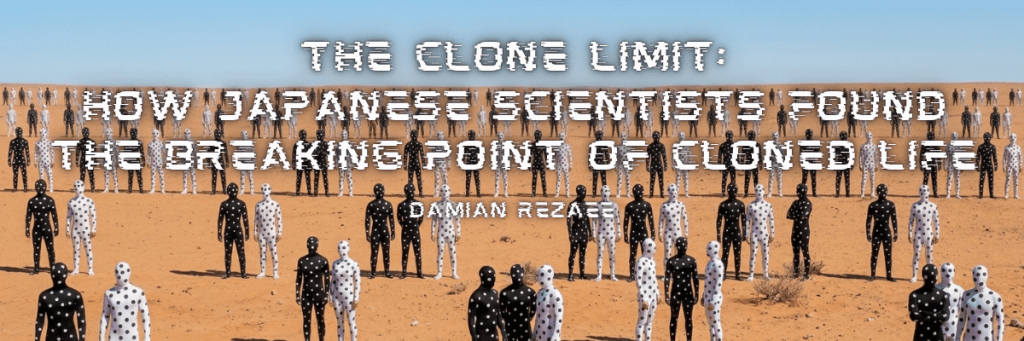
For decades, cloning carried an implicit promise: that life, once decoded, could be reproduced on demand. Dolly the sheep proved in 1996 that a mammal could be cloned. What science had never truly tested was whether that process could continue indefinitely.
A long-running experiment in Japan now suggests that it cannot.
Researchers at the University of Yamanashi spent roughly twenty years producing successive generations of cloned mice, each one copied from the last. In total, they produced more than 1,200 cloned mice from a single original donor. The lineage could not be sustained beyond the 58th generation, and the birth rate had already begun declining from the 27th generation onward (Wakayama et al., 2026). Reuters reported that 1,206 cloned mice were produced between 2005 and 2025, and that the 58th-generation mice died within days of birth despite showing no visible abnormalities (Dunham, 2026).
The breakdown was not random. It followed a recognizable evolutionary pattern: the accumulation of harmful mutations in a lineage that reproduces without recombination.
In the Nature Communications paper, Wakayama and colleagues found that large structural and lethal mutations accumulated across generations of serially cloned mice (Wakayama et al., 2026). Later-generation clones also showed worsening reproductive outcomes. When researchers tested oocytes from near-final-generation cloned mice, embryo development collapsed sharply compared with controls, indicating that the mutational burden had become biologically consequential rather than merely detectable in sequencing data (Wakayama et al., 2026). This is the point where cloning stops being a story about technical repetition and becomes a story about biological erosion. A system may keep producing copies for a while, but once the quality of those copies keeps declining, reproduction has shifted from persistence to decay.
This matters because cloning had long been associated with the idea of exact copying. That assumption no longer holds up well. Reuters, summarizing the study and comments from lead researcher Teruhiko Wakayama, reported that mutations occurred in the clones at roughly three times the rate seen in offspring from natural mating, and that later generations displayed large-scale chromosomal abnormalities, including the loss of an X chromosome in some cases (Dunham, 2026). In other words, the clone was never a perfect replay of the original. Errors entered early, and repeated copying compounded them. That makes this study important beyond cloning itself. It challenges a broader technological fantasy: the belief that once something biological is copied, it is preserved. Preservation is not the same as duplication. Biology can retain outward resemblance while losing internal stability.
The broader biological logic behind this result fits a long-established theory known as Muller’s ratchet. In non-recombining lineages, harmful mutations can accumulate irreversibly because there is no recombination process to help separate deleterious variants from less-damaged genomes. As Charlesworth (2017) explains, Muller’s ratchet describes the irreversible accumulation of deleterious mutations due to drift in the absence of recombination and back mutation. The Yamanashi experiment gives that theory an unusually concrete form in a mammalian system. It does not merely model mutation accumulation. It tracks the decline of a cloned lineage over twenty years until the process fails. The significance here is intellectual as much as experimental. Biology had long predicted this kind of one-way deterioration in asexual systems. What the Japanese team did was force that prediction into visible reality. They turned an abstract evolutionary mechanism into a measurable mammalian limit.
One of the most striking findings in the study is that sexual reproduction partially restored what serial cloning could not preserve. Wakayama et al. (2026) found that even near the end of the cloning chain, some offspring produced through meiosis and fertilization developed to full term, suggesting that sexual reproduction helps eliminate genetic anomalies caused by clonal reproduction. The paper states this directly: mammals appear to rely on sexual rather than asexual reproduction to eliminate the anomalies generated through repeated cloning (Wakayama et al., 2026).
That point deserves emphasis. Sexual reproduction is often discussed as one reproductive pathway among others. This study frames it differently. In mammals, sex appears to function as a repair system as much as a reproductive strategy. The study showed that litter sizes in later-generation re-cloned mice dropped sharply, yet some developmental capacity could still be recovered once normal fertilization reintroduced meiotic reshuffling and paternal genetic input (Wakayama et al., 2026). What serial cloning accumulates, sexual reproduction can at least partly filter out. That insight matters because it reframes sex as a maintenance technology built into life itself. It is not simply a means of generating offspring. It is one of the main ways complex organisms prevent inherited damage from hardening into permanent lineage collapse.
The implications extend beyond laboratory mice. Serial cloning has often been imagined as a tool for conservation, especially for preserving endangered species from archived cells. It has also been discussed as a possible route for scaling certain forms of animal production. This new evidence forces a harder question: what happens if a population is rebuilt through repeated copying rather than through reproduction that includes recombination?
The answer from this experiment is sobering. A lineage rebuilt entirely through serial cloning would not simply remain frozen in genetic time. It would drift, degrade, and eventually fail under the weight of accumulated mutations. That does not mean cloning has no scientific or practical value. It does mean cloning is not a biologically stable substitute for long-term mammalian reproduction under current methods. This is where the conservation argument becomes more fragile than it first appears. Cloning may still be useful as a temporary rescue tool, especially when genetic options are limited, but this study suggests it cannot serve as a self-sustaining foundation for rebuilding mammalian populations over time.
This also raises a modern question: can artificial intelligence help overcome the clone limit?
The honest answer is that AI can help, but it cannot solve the problem on its own. The limit exposed by the Japanese study is not mainly a thinking problem. It is a biological problem involving mutation accumulation, chromosomal instability, and incomplete epigenetic reprogramming. AI may become useful in identifying high-risk mutations, screening cell lines, predicting developmental failure, improving lab automation, and helping researchers decide which embryos or nuclei are worth advancing. These are meaningful contributions, especially in an area where serial cloning requires repeated decisions across large numbers of embryos and transfer attempts.
But AI does not repair a chromosome by predicting that it is broken. It does not restore developmental viability simply by identifying a pattern. Even a highly capable AI system would still depend on biotechnology to do the real corrective work. That means more precise gene-editing systems, better nuclear transfer methods, improved epigenetic resetting, and more rigorous cell-quality selection before cloning begins. In that sense, AI could raise the ceiling by helping scientists detect and manage risk more effectively. It cannot remove the ceiling unless biological tools themselves become capable of correcting the damage that repeated cloning creates. The deeper lesson is that intelligence and intervention are not the same thing. AI may become very good at seeing the failure earlier, classifying it better, and helping researchers respond more efficiently. But insight does not equal repair. Computation can guide biology, yet it cannot replace the physical mechanisms life depends on to remain viable.
That distinction matters. AI may become part of the cloning pipeline, but it is not a substitute for the reproductive logic that mammals already rely on. The lesson of this study is not that science lacks enough data. It is that copying alone is not enough to preserve life across generations. This is also why the phrase “copying life” can be misleading. What is being copied is form, genotype, or cellular source material, but life across generations depends on processes that do more than replicate structure. They also correct, reshuffle, and absorb damage.
The study also carries a conceptual lesson. Biology is not a photocopier. A living organism is not sustained by copying alone. It is sustained by systems of correction, reshuffling, and selection that preserve viability across generations. Cloning can reproduce form, but this study suggests it cannot indefinitely preserve genomic integrity in mammals as presently practiced. That is the real boundary the Japanese experiment uncovered. The limit is not merely how many times scientists can perform nuclear transfer. The limit is how many times life can be copied before the absence of renewal begins to overpower the act of reproduction itself.
That is why the mouse result matters. It does not simply mark a technical limit in one research program. It clarifies something deeper about life itself. The promise of infinite copying was always more fragile than it seemed. After 1,200 mice and twenty years of work, the evidence now suggests that mammalian life cannot be cloned forever, because reproduction is not just about duplication. It is also about renewal. And that may be the most important takeaway of all: biological survival does not come from sameness alone. It comes from a system’s ability to preserve continuity while still allowing correction. Cloning reproduces continuity. Sexual reproduction preserves continuity by preventing error from becoming destiny.
References
Charlesworth, B. (2017). Population genetics from 1966 to 2016. Heredity, 118(1), 2-9. https://doi.org/10.1038/hdy.2016.55
Dunham, W. (2026, March 24). Mouse study shows repeated cloning causes grave genetic mutations. Reuters.
Wakayama, S., Nakata, K., Nakano, K., Kamimura, S., Liu, S., Wang, X., Kishigami, S., Mizutani, E., Inoue, K., & Wakayama, T. (2026). Limitations of serial cloning in mammals. Nature Communications, 17, Article 2532. https://doi.org/10.1038/s41467-026-69765-7


Leave a Reply