By Damian Rezaee
Introduction
In December 2015, a group of technology researchers and investors founded OpenAI as a nonprofit artificial intelligence organization with the stated mission of ensuring that artificial general intelligence (AGI) benefits all of humanity (OpenAI, 2025). Within two years, the organization introduced what would become one of the most recognizable visual symbols associated with contemporary artificial intelligence: a geometric, interlocking emblem now referred to in OpenAI’s brand system as the “Blossom” (OpenAI, 2025). OpenAI describes the Blossom as representing “the dynamic intersection between humanity and technology” (OpenAI, 2025, para. 4). Over time, the symbol has become closely associated with ChatGPT and with OpenAI’s broader public identity.
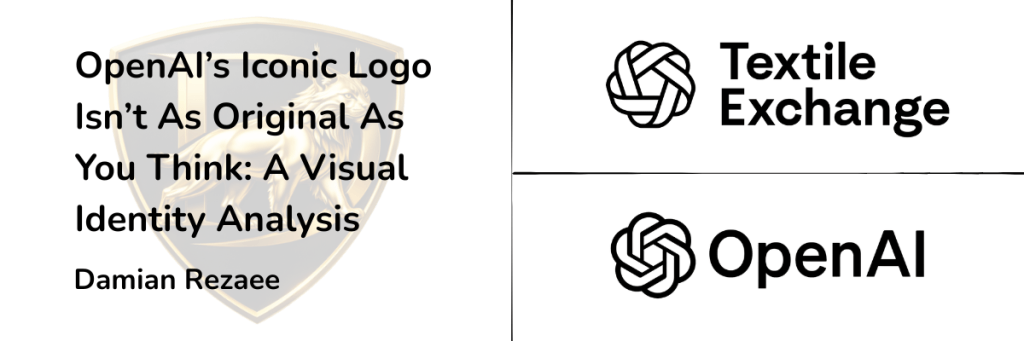
A comparison with the logo of Textile Exchange reveals a striking visual resemblance that appears to have received little sustained public attention. Textile Exchange is a sustainability-focused global nonprofit organization that emerged from Organic Exchange and adopted its current name in 2010 (Textile Exchange, 2023). Since that rebrand, the organization has used a woven, interlocking circular emblem rendered in monochrome. The mark shares notable formal characteristics with OpenAI’s Blossom, including an interwoven circular structure, rotational symmetry, thick continuous strokes, and a flower- or knot-like overall shape. Although the two organizations operate in very different sectors, the visual similarity between their marks raises important questions about distinctiveness, visual identity development, and the scope of logo clearance practices across sectors.
This paper proceeds in four parts. First, it presents a formal visual analysis of the two logos in order to document the extent of their structural similarity. Second, it considers what that similarity may suggest about the limits of design due diligence and cross-sector clearance practices. Third, it situates the case within the broader literature on geometric logo design, brand identity, and trademark law. Finally, it offers recommendations for more rigorous visual identity clearance processes that may help organizations reduce the likelihood of comparable oversights.
Visual Analysis of Both Logos
A formal comparison of the two marks reveals substantial visual similarity in their underlying design structure. OpenAI’s Blossom is a circular, interlocking emblem composed of curved segments that create the appearance of a woven, knot-like figure. The mark combines geometric order with a sense of organic flow, producing a compact, symmetrical symbol within a circular boundary. In OpenAI’s own brand language, the symbol is intended to represent the meeting point of humanity and technology (OpenAI, 2025).
The Textile Exchange logo employs a highly comparable design vocabulary. Its emblem is also circular, interwoven, and symmetrical, with thick monochrome strokes forming a woven structure that produces a layered, rounded figure. Both marks rely on continuous line forms, rotational balance, circular containment, and the visual metaphor of interconnection through weaving or knotting. When viewed side by side, the resemblance is immediately noticeable, particularly at a glance or in small-scale digital contexts where accompanying brand names may be less prominent.
The timeline of the two marks is also significant. Textile Exchange adopted its current identity in 2010 following its rebrand from Organic Exchange (Textile Exchange, 2023). OpenAI introduced the Blossom several years later. This chronology does not by itself establish copying, nor does it create a legal conclusion. It does, however, establish that Textile Exchange’s emblem predates OpenAI’s visually similar mark. The comparison is therefore analytically meaningful, especially because the two logos emerged in different sectors yet rely on a closely related formal language.
OpenAI’s 2025 brand refresh retained the core structure of the Blossom while refining aspects of its geometry and application (Creative Review, 2025; OpenAI, 2025). This continuity indicates that the central visual form has remained stable over time. As a result, the resemblance between the two marks is not limited to a brief or transitional design phase, but instead concerns a symbol that has become central to OpenAI’s public identity.
Design Due Diligence: What the Similarity Reveals
The key question raised by this case is not simply whether the logos look similar; that similarity is visually apparent. The more important question is what the existence of such a resemblance may suggest about the design and clearance process behind OpenAI’s mark. While the available evidence does not support a claim of deliberate copying, it does raise legitimate questions about the breadth and depth of logo clearance practices in cases where organizations operate outside one another’s immediate commercial sphere.
For a well-resourced organization, professional logo development would ordinarily be expected to involve some form of trademark and visual similarity review prior to release. Such reviews may include trademark database searches, design classification searches, and broader scans of comparable marks already in use (Dinwoodie & Janis, 2014). The purpose of these processes is to reduce legal risk, protect distinctiveness, and identify prior marks that may create reputational or strategic complications. In this case, the existence of a pre-existing, publicly used nonprofit mark with strong visual similarities suggests, at minimum, that conventional clearance methods may not always capture relevant cross-sector parallels.
At the same time, it is important not to overstate the conclusion. The evidence does not show that OpenAI intentionally copied Textile Exchange, and the absence of any public dispute between the two organizations may reflect the fact that they operate in very different industries with little likelihood of consumer confusion. Independent convergence is entirely plausible, especially in a design environment where circular, interlocking, and woven motifs are widely used to symbolize connection, complexity, and systems thinking (Henderson & Cote, 1998). The case is therefore best interpreted not as proof of misconduct, but as an example of how visually similar outcomes can emerge even when legal conflict does not.
Even so, the comparison remains significant. A globally recognized organization released a mark that bears a strong resemblance to an earlier nonprofit logo already in public use. That result suggests a possible gap in standard clearance practice, especially if those practices are oriented primarily toward commercial competitors or industry-adjacent organizations rather than toward the wider ecosystem of nonprofits, associations, and civil society institutions. In that sense, the case points less to intentional appropriation than to the limitations of conventional due diligence frameworks.
This interpretation becomes especially interesting in light of OpenAI’s broader public visibility in debates over intellectual property and creative ownership. Although those legal disputes concern different issues, they have contributed to a public environment in which questions of originality, attribution, and responsible use of creative material are especially salient for the company (Grynbaum & Mac, 2023). The logo comparison does not establish legal wrongdoing, but it does add an additional layer to broader discussions about how originality is evaluated, communicated, and protected in high-profile organizations.
The geographic dimension strengthens this interpretation. Both Textile Exchange and OpenAI are American organizations operating within the same national legal, commercial, and media environment. Textile Exchange’s mark had been publicly used in the United States for years before OpenAI introduced the Blossom. This does not prove exactly how OpenAI’s clearance process was conducted, but it does weaken the argument that the earlier mark was too remote or inaccessible to be discoverable. At minimum, the case suggests that conventional clearance practices may be too narrowly focused on direct commercial competitors and may overlook visually similar marks used by nonprofit organizations in adjacent public spaces.
Contextualizing the Similarity: Geometric Logos, Brand Identity, and Intellectual Property
To assess the significance of this resemblance properly, it is necessary to place it within the broader landscape of logo design. Technology brands, and AI brands in particular, frequently rely on circular, interlocking, and woven forms to communicate ideas such as intelligence, networks, complexity, and integration. These forms are visually efficient because they condense abstract concepts into compact, memorable structures. OpenAI’s Blossom fits comfortably within this broader design tendency, as does the Textile Exchange logo within the sustainability sector’s preference for symbols of interdependence and circularity.
Because these motifs are common, independent convergence is not surprising. Henderson and Cote (1998) note that effective logos often rely on familiar visual structures that are easily processed, recognized, and remembered. This necessarily constrains the range of available forms. In trademark law, moreover, visual similarity alone is not enough to establish infringement; likelihood of confusion depends on a wider set of factors, including market overlap, context of use, and consumer perception (Dinwoodie & Janis, 2014). On those grounds, a strong legal claim between OpenAI and Textile Exchange appears unlikely, given the significant distance between their sectors and audiences.
The legal issue, however, is only part of the story. Brand identity also operates at a symbolic and strategic level. Aaker (1991) defines brand identity as the set of associations an organization seeks to create and maintain. Logos matter because they compress those associations into a single visual form. When two organizations arrive at highly similar symbols, the issue is not necessarily legal confusion but reduced distinctiveness. A mark can remain legally defensible while still raising questions about originality and uniqueness.
From a brand management perspective, the issue is not only whether the two logos look alike. It is whether a logo can function effectively as a distinctive asset if a highly similar symbol already exists. Romaniuk (2018) argues that distinctive brand assets are valuable because they help people quickly recognize and connect a cue to the correct brand. Romaniuk and Sharp (2021) similarly argue that brands grow by building memory structures that make them easier to notice and recall. In that context, a logo is not just a design element. It is a memory cue. If that cue is too similar to an earlier mark, its strategic value may be weakened even if no legal confusion occurs.
This point makes the comparison strategically important. If a logo is expected to strengthen recognition and improve the linkage between a symbol and a brand name, then similarity to an earlier mark matters even when the two organizations do not compete directly. A brand asset may remain legally usable while still being strategically weaker than it should be. For highly visible organizations in particular, the standard should not be limited to legal separability. It should also include whether the asset is distinctive enough to support awareness, recall, and clear brand linkage over time (Romaniuk, 2018; Romaniuk & Sharp, 2021).
The conceptual dimension of the comparison is also notable. Textile Exchange uses a woven circular form that naturally aligns with textiles, fibers, and interdependence across supply chains. OpenAI uses a comparable form to symbolize the interrelationship of human and technological systems. In other words, both organizations appear to have drawn on the broader metaphor of interconnectedness and translated that metaphor into a woven circular emblem. This convergence exists not only at the level of shape, but also at the level of symbolic meaning, which makes the comparison analytically richer than a simple claim of surface resemblance.
The scale of OpenAI’s visibility amplifies the relevance of the case. Because the Blossom has become deeply associated with ChatGPT and with public understandings of artificial intelligence, its visual distinctiveness matters beyond the narrow boundaries of corporate branding. The comparison with Textile Exchange therefore, has broader significance as a case study in how highly visible symbols can emerge from already occupied areas of visual design space without generating immediate public scrutiny.
Recommendations for Visual Identity Clearance Practice
The comparison between OpenAI’s Blossom and the Textile Exchange emblem suggests a need for more expansive logo clearance practices. Several practical steps may help organizations reduce the risk of developing marks that are highly similar to existing visual identities.
First, trademark searches should be supplemented by broader cross-sector visual reviews. Registered trademark databases are essential, but they do not capture the full universe of marks in public use. In the United States, common law rights can arise through use even without registration, and reputational concerns may arise regardless of legal registration status (Dinwoodie & Janis, 2014). Clearance practices should therefore extend beyond direct commercial competitors to include nonprofits, associations, academic institutions, and other publicly visible organizations.
Second, organizations should incorporate image-based similarity tools into the clearance process. Visual comparison technologies can help identify structural parallels that may be missed in word-based or sector-limited searches. While no tool is exhaustive, such systems can improve the likelihood of surfacing relevant visual similarities at an early stage in development.
Third, design teams should engage with classification systems and visual typologies during concept development rather than only during final legal review. Doing so can help identify oversaturated categories of marks and encourage movement toward more distinctive formal territory before a concept is finalized.
Fourth, clearance should be treated not only as a legal exercise but also as a strategic brand exercise. A mark may avoid legal conflict while still creating avoidable questions about originality, especially once it enters wide public circulation. For highly visible organizations, distinctiveness should be evaluated in reputational as well as legal terms. This is especially important in light of brand management research showing that logos and other identity cues work as distinctive assets and memory triggers that support recognition, recall, and brand linkage (Romaniuk, 2018; Romaniuk & Sharp, 2021).
Finally, reverse image search and publicly indexed web searches should be used as a practical final-stage check before release. These methods are imperfect, but they provide a relatively simple way to identify publicly visible analogues that may not appear in specialized legal databases.
Conclusion
The visual similarity between OpenAI’s Blossom and the earlier Textile Exchange emblem is substantial and worthy of analysis. Textile Exchange adopted its current logo in 2010, years before OpenAI introduced the Blossom. The two marks share a notably similar formal vocabulary, including interwoven circular structure, rotational symmetry, monochrome execution, and the visual suggestion of weaving or knotting. They also rely on related symbolic associations with interconnection and complex systems.
The available evidence does not support a claim of deliberate copying, nor does it by itself establish legal wrongdoing. It does, however, raise meaningful questions about the limits of conventional logo clearance practices, especially when organizations in different sectors draw from the same visual and conceptual design space. The broader significance of the case lies less in legal accusation than in what it reveals about distinctiveness, originality, and cross-sector blind spots in visual identity development.
Viewed through a brand management lens, the case becomes even more significant. If logos function as distinctive assets that help build recognition and memory, then their strategic value depends on how clearly and uniquely they signal one brand. The OpenAI and Textile Exchange comparison, therefore, matters not only because the marks look alike, but because visual similarity may reduce the strength of a logo as a uniquely owned brand cue. In that sense, the case reinforces the importance of evaluating logos not only for legal defensibility but also for their contribution to distinctiveness, memory structures, and long-term brand strength (Romaniuk, 2018; Romaniuk & Sharp, 2021).
More broadly, this case illustrates the importance of treating logo clearance as both a legal and strategic process. Cross-sector visual sweeps, image-based similarity tools, broader review of publicly used marks, and greater attention to symbolic overlap can all strengthen the development of distinctive and defensible visual identities. The purpose of this paper has not been to prove misconduct, but to document a striking case of visual convergence and to use that case to illuminate a broader issue in contemporary brand design practice.
References
Aaker, D. A. (1991). Managing brand equity: Capitalizing on the value of a brand name. Free Press.
Creative Review. (2025, February). OpenAI’s brand refresh subtly signals a new era. https://www.creativereview.co.uk/openai-brand-refresh/
Dinwoodie, G. B., & Janis, M. D. (2014). Trademarks and unfair competition: Law and policy (4th ed.). Wolters Kluwer.
Grynbaum, M. M., & Mac, R. (2023, December 27). The Times sues OpenAI and Microsoft over A.I. use of copyrighted work. The New York Times. https://www.nytimes.com/2023/12/27/business/media/new-york-times-open-ai-microsoft-lawsuit.html
Henderson, P. W., & Cote, J. A. (1998). Guidelines for selecting or modifying logos. Journal of Marketing, 62(2), 14–30. https://doi.org/10.1177/002224299806200202
OpenAI. (2025). OpenAI brand guidelines. https://openai.com/brand/
Romaniuk, J. (2018). Building distinctive brand assets. Oxford University Press.
Romaniuk, J., & Sharp, B. (2021). How brands grow part 2 (Rev. ed.). Oxford University Press.
Textile Exchange. (2023, April 17). Our story. https://textileexchange.org/our-story/
 Damian Rezaee
Leave a comment