By Damian Rezaee
Introduction
In the rarified echelon of hyper-luxury automotive manufacturing, Bugatti occupies a singular position that transcends conventional market categories. Founded in 1909 by Italian-born French automobile designer Ettore Bugatti in Molsheim, France, the marque has evolved from early-twentieth-century racing dominance to contemporary hypercar supremacy, maintaining an unwavering commitment to the founder’s dictum: “If comparable, it is no longer Bugatti” (Kapferer, 2012, p. 187). This philosophical foundation establishes Bugatti not as a mere automobile manufacturer but as the creator of incomparable mechanical art objects that synthesize aesthetic excellence, engineering innovation, and performance supremacy. Bugatti’s excellence is not accidental or improvised, but the result of invisible preparation, systems, and disciplined design.
The contemporary hypercar market, valued at $34.48 billion in 2025 and projected to reach $242.34 billion by 2033 (representing a 27.6% CAGR), presents unique branding challenges distinct from traditional automotive sectors (SkyQuest Technology, 2025). Unlike mass-market manufacturers pursuing volume growth or premium brands balancing exclusivity with accessibility, hypercar producers operate in a paradoxical space wherein extreme scarcity drives desirability, production limitations sustain pricing power, and each vehicle functions simultaneously as a transportation device, investment asset, and cultural artifact. Within this competitive landscape, Bugatti competes against established rivals including Ferrari, Lamborghini, McLaren, and Mercedes-AMG, as well as boutique hypercar specialists Koenigsegg and Pagani, each offering distinct value propositions to ultra-high-net-worth individuals (UHNWIs).
This comprehensive analysis examines Bugatti’s brand management strategies through multiple theoretical frameworks, with particular emphasis on Keller’s (1993, 2001) Customer-Based Brand Equity (CBBE) Model and monolithic brand architecture theory. Keller’s CBBE framework posits that brand equity derives from customer knowledge, defined as the differential effect of brand knowledge on consumer responses to marketing activities (Keller, 1993). The model’s pyramid structure progresses through four hierarchical levels: brand identity or salience, brand meaning or performance and imagery, brand response or judgments and feelings, and finally brand resonance, which is the apex representing active engagement, behavioral loyalty, attitudinal attachment, and sense of community (Keller, 2001). By applying this framework to Bugatti, this research demonstrates how the marque has systematically constructed brand equity across all pyramid levels, thereby achieving resonance among its exclusive clientele.
Complementing the CBBE analysis, this study examines Bugatti’s monolithic brand architecture, which is a structural approach in which all products and services carry the singular corporate brand identity (Aaker & Joachimsthaler, 2000). Unlike competitors employing sub-brand strategies, such as Ferrari’s Special Series designation, or endorsed architectures, such as Lamborghini’s collaboration with Ducati, Bugatti maintains absolute consistency in brand presentation, differentiating products through model nomenclature rather than distinct sub-brand identities. This architectural choice carries profound implications for brand equity transfer, marketing efficiency, and customer perception, all of which this research explores in detail.
The research objectives guiding this analysis are fivefold:
1. To analyze Bugatti’s brand management strategies through Keller’s CBBE Model framework, demonstrating how the marque has progressed from brand salience to brand resonance
2. To examine Bugatti’s monolithic brand architecture and portfolio strategy, explaining product scope, brand architecture decisions, and competitive implications
3. To provide a detailed architectural analysis of four distinct portfolio products (Bugatti Chiron, Divo, Centodieci, and W16 Mistral), demonstrating portfolio diversity within unified brand identity
4. To identify and analyze Bugatti’s distinctive brand assets (horseshoe grille, C-line, macaron emblem, color palette, typography), explaining their historical origins and contemporary representation
5. To propose strategic recommendations for strengthening distinctive brand assets to enhance physical and mental availability while respecting ultra-luxury positioning constraints
This study contributes to academic and practitioner knowledge in several significant ways. First, it applies Keller’s CBBE Model to an ultra-luxury context wherein traditional marketing principles (market penetration, volume growth, price elasticity) operate fundamentally differently than in mass or premium markets. Second, it demonstrates how monolithic brand architecture functions in hypercars pace where product diversity must coexist with absolute brand consistency. Third, it provides an empirical examination of how heritage-based distinctive brand assets create sustainable competitive advantage across century-spanning timeframes. Fourth, it analyzes the strategic challenges of balancing electrification imperatives with traditional powerplant preferences in luxury automotive contexts. Finally, it offers actionable recommendations for enhancing brand asset effectiveness in driving both mental availability (brand salience and consideration) and physical availability (purchase facilitation) in ultra-exclusive market segments.
The remainder of this article proceeds as follows. Section 2 presents theoretical foundations, reviewing Keller’s CBBE Model, monolithic brand architecture theory, and luxury brand extension strategies. Section 3 analyzes Bugatti’s brand management strategies, positioning, and competitive environment. Section 4 examines brand portfolio strategy and architecture. Section 5 provides a detailed architectural analysis of four portfolio products. Section 6 identifies and analyzes distinctive brand assets. Section 7 proposes strategies for strengthening brand assets to enhance availability. Section 8 discusses implications, limitations, and future research directions. Section 9 concludes.
Theoretical Foundations
Keller’s Customer-Based Brand Equity Model
Kevin Lane Keller’s Customer-Based Brand Equity (CBBE) Model, introduced in his seminal 1993 Journal of Marketing article and refined in subsequent work (2001, 2013), represents the dominant framework for understanding how brands create value through customer knowledge structures. Keller (1993) defines customer-based brand equity as “the differential effect of brand knowledge on consumer response to the marketing of the brand” (p. 2). This conceptualization emphasizes that brand equity resides not in physical assets or financial statements but in consumer minds, specifically in the associations, perceptions, attitudes, and behaviors that brand knowledge evokes.
The CBBE Model employs a pyramid metaphor comprising four progressive levels, each answering fundamental customer questions (Keller, 2001):
Level 1: Brand Identity (Salience) – Who Are You?
Brand salience encompasses the breadth and depth of brand awareness, meaning the frequency and ease with which the brand comes to mind across purchasing and consumption situations (Keller, 2001). Salience operates along two dimensions: brand recognition, which is the ability to confirm prior exposure when given the brand as a cue, and brand recall, which is the ability to retrieve the brand from memory when given a product category, need, or usage situation as a cue. High salience means that customers think of the brand under diverse circumstances, across multiple product categories, and in both planned and spontaneous purchase occasions. For ultra luxury brands like Bugatti, salience manifests not through mass market awareness but through absolute dominance within relevant consideration sets among target UHNWIs.
Level 2: Brand Meaning – What Are You?
Brand meaning comprises two sub-dimensions: performance and imagery. Brand performance addresses functional product or service delivery, encompassing primary characteristics, product reliability, service effectiveness, style and design, and price (Keller, 2001). Performance associations answer whether the brand meets functional needs effectively. Brand imagery encompasses intangible associations, including user profiles, purchase and usage situations, personality and values, history and heritage, and experiences. Imagery associations address how the brand meets psychological and social needs. Together, performance and imagery create a holistic brand meaning that differentiates offerings and establishes positioning (Keller, 2013). In hypercar contexts, performance associations include engineering specifications, speed records, and technological innovations, while imagery encompasses brand heritage, ownership communities, and cultural positioning.
Level 3: Brand Response – What About You?
Brand response similarly divides into judgments and feelings. Brand judgments are customers’ personal opinions and evaluations regarding quality, credibility, consideration, and superiority (Keller, 2001). These cognitive assessments compare brand performance against competitive alternatives and usage requirements. Brand feelings represent customers’ emotional responses and reactions to the brand, including warmth, fun, excitement, security, social approval, and self-respect (Keller, 2001). Positive judgments and feelings emerge from consistently delivering meaningful brand performance and imagery, creating preference and attachment. For ultra-luxury brands, judgments often emphasize absolute quality and uncompromising superiority, while feelings center on self-actualization, achievement validation, and community membership.
Level 4: Brand Resonance – What About You and Me?
Brand resonance represents the apex of the CBBE pyramid and the ultimate brand customer relationship, characterized by deep psychological bonds and active engagement (Keller, 2001). Resonance manifests through four dimensions: behavioral loyalty, attitudinal attachment, sense of community, and active engagement. Behavioral loyalty includes repeat purchases and share of category requirements. Attitudinal attachment refers to brand love and special purchase designation. Sense of community reflects affiliation with other brand users and company representatives. Active engagement refers to the willingness to invest time, energy, money, and resources beyond purchase. Achievement of brand resonance represents the culmination of strategic brand-building efforts across all lower pyramid levels. Brands that achieve resonance command price premiums, generate positive word of mouth, resist competitive attacks, and create self-perpetuating loyalty cycles (Keller, 2013).
Empirical research validates the CBBE Model’s predictive power. Nielsen (2023) found that brands actively managing equity using structured models like CBBE experience 25% higher customer retention rates compared to brands employing ad hoc approaches. BrandZ (2023) demonstrated that strong brand resonance correlates with 30% increases in brand loyalty and significant amplification of word-of-mouth referrals. These findings underscore the model’s practical utility for guiding brand-building investments and measuring outcomes. However, the CBBE Model application to ultra-luxury contexts requires contextual adaptation, as market dynamics, purchase behaviors, and relationship structures differ fundamentally from mass or premium markets analyzed in the original CBBE research.
Monolithic Brand Architecture Theory
Brand architecture refers to the hierarchical structure organizing brands within a corporate portfolio, defining relationships between corporate brands, business unit brands, and product brands (Aaker & Joachimsthaler, 2000). Strategic brand architecture decisions determine how brand equity transfers between levels, how resources are allocated across brands, and how consumers navigate brand families. Three primary architectural approaches exist: monolithic (branded house), endorsed, and pluralistic (house of brands), with hybrid variations combining elements (Aaker & Joachimsthaler, 2000; Kapferer, 2012).
Monolithic brand architecture employs a single, overarching brand name across all offerings, with the corporate brand serving as a dominant identity element for all sub-brands and extensions (Aaker & Joachimsthaler, 2000). Product differentiation occurs through descriptors rather than distinct brand identities. Classic examples include Virgin (Virgin Atlantic, Virgin Media, Virgin Galactic), FedEx (FedEx Express, FedEx Ground, FedEx Office), and Apple (iPhone, iPad, MacBook). This architectural approach offers several strategic advantages:
1. Marketing efficiency: Consolidated marketing expenditures build a singular brand rather than fragmenting across multiple identities, creating economies of scale in awareness-building and brand development (Aaker & Joachimsthaler, 2000)
2. Brand equity transfer: Positive associations with the corporate brand automatically transfer to new products, reducing market entry risks and accelerating acceptance (Kapferer, 2012)
3. Coherent brand experience: Consistent identity across touchpoints creates a unified customer experience, reinforcing brand promise and strengthening recognition (Keller, 2013)
4. Crisis resistance: A strong corporate brand can support troubled product lines; conversely, corporate reputation benefits from any product’s success (Aaker & Joachimsthaler, 2000)
However, monolithic architecture also presents challenges. Product diversity can dilute brand meaning if extensions venture too far from core associations (Keller & Lehmann, 2006). One product’s failure can tarnish the entire brand portfolio. Brand positioning may become confused if products target diverse segments with conflicting value propositions. Additionally, monolithic architecture limits flexibility in separately positioning product lines to optimize market fit (Aaker & Joachimsthaler, 2000).
In automotive contexts, monolithic architecture manifests distinctly across market segments. BMW employs modified monolithic architecture with model designations (3 Series, 5 Series, 7 Series, X3, X5) differentiated by descriptors while maintaining BMW brand dominance. This approach enables product line differentiation while leveraging corporate brand equity. For ultra-luxury manufacturers like Bugatti operating in hypercar segments, monolithic architecture serves additional strategic purposes: it maintains brand exclusivity by preventing sub-brand proliferation, ensures consistent ultra-luxury positioning across products, and prevents internal brand competition that could undermine scarcity economics.
Luxury Brand Extension Strategies
Brand extension—leveraging established brand equity to enter new product categories or market segments—represents a critical growth strategy for luxury brands facing maturity in core markets (Sheinin & Schmitt, 1994). Extension strategies divide into horizontal (new product categories at similar quality/price levels) and vertical (same category at different quality/price tiers) approaches, each carrying distinct risks and opportunities (Boisvert & Ashill, 2018).
Horizontal extensions introduce products in different categories while maintaining luxury positioning. Examples include Bulgari Hotels extending from jewelry, Hermès fragrances extending from leather goods, and Porsche Design consumer electronics extending from automotive. Success requires perceived fit between parent brand and extension category, alignment of brand values across categories, and complementary rather than contradictory positioning (Ahn et al., 2018). Horizontal extensions can strengthen brand equity by demonstrating lifestyle breadth and attracting new customer segments while preserving core positioning.
Vertical extensions move upmarket or downmarket from the parent brand’s established price/quality positioning. Upscale vertical extensions (e.g., ultra-limited special editions at premium pricing) enhance prestige and aspirational appeal but offer limited volume growth given constrained addressable markets. Downward vertical extensions (e.g., entry-level models at accessible price points) expand customer bases and revenues but risk brand dilution and prestige erosion (Riley et al., 2015). Research demonstrates that downward extensions particularly threaten luxury brands, as association with lower-quality offerings can contaminate parent brand image and alienate existing customers valuing exclusivity (Kim et al., 2001).
For ultra-luxury automotive brands, extension strategies typically avoid downward movement given extreme dilution risks. Instead, these brands employ lateral and upscale approaches: derivative models based on core platforms but with performance differentiation (e.g., Bugatti Divo versus Chiron), ultra-exclusive limited editions commanding substantial premiums (e.g., Bugatti Centodieci), and coachbuilt one-offs representing absolute customization (e.g., Bugatti La Voiture Noire). These extensions maintain or elevate positioning while creating perceived variety that sustains collector engagement and enables additional revenue extraction from existing customer bases.
Bugatti Brand Management Strategies
Applying Keller’s CBBE Model to Bugatti
Brand Salience: Establishing Incomparable Identity
Bugatti has achieved extraordinary brand salience within its target market of ultra-high net worth individuals despite, and in some ways because of, minimal traditional marketing expenditures and an absent mass market presence. This seemingly paradoxical achievement reflects the strategic cultivation of exclusivity, where scarcity itself drives brand awareness among relevant constituencies. Within hypercar consideration sets, Bugatti achieves near universal unaided recall, with the marque functioning as a synonym for ultimate automotive achievement (Gerlach & Witt, 2012).
Several factors contribute to Bugatti’s salience dominance. First, record-breaking performance achievements create earned media amplification that money cannot buy. The Veyron’s 2005 achievement as the first production car exceeding 250 mph, the Veyron Super Sport’s 2010 267.8 mph world record, and the Chiron Super Sport 300+’s 2019 breach of the 300 mph barrier generated global media coverage valued in hundreds of millions of dollars. These engineering milestones establish Bugatti as the definitive speed benchmark, ensuring the brand comes to mind whenever discussions turn to ultimate automotive performance.
Second, Bugatti’s distinctive visual identity creates instant recognition. The horseshoe grille, introduced on the 1924 Type 35, represents one of the most recognizable design elements in automotive history. A 2023 consumer recognition study found that among automotive enthusiasts, the horseshoe grille achieved 94% unaided recognition when shown in isolation, surpassing even mass market icons such as the Mercedes-Benz three-pointed star or BMW kidney grilles. This visual distinctiveness ensures that Bugatti salience extends beyond verbal brand knowledge to visceral visual recognition.
Third, Bugatti actively cultivates salience through selective presence at ultra-luxury lifestyle events. Rather than pursuing volume-oriented auto shows, Bugatti appears at exclusive venues including Pebble Beach Concours d’Elegance, Goodwood Festival of Speed, Geneva International Motor Show, and private gatherings for existing owners and prospective customers. This selectivity reinforces exclusivity while ensuring presence in contexts where target customers congregate. Additionally, Bugatti leverages showroom architecture and location strategy to maximize salience impact: the 34 worldwide showrooms occupy premium locations in luxury retail districts, with architectural design emphasizing the horseshoe grille element and Bugatti blue color palette.
Brand Performance: Engineering Excellence as Foundation
Bugatti’s brand performance associations center on uncompromising engineering excellence manifested through technical specifications that consistently surpass competitive benchmarks. The contemporary W16 platform exemplifies this commitment. The 8.0-liter quad turbocharged W16 engine architecture, which is unique to Bugatti and was developed at enormous cost, produces up to 1,600 PS or 1,578 hp in Centodieci specification. This powertrain’s complexity, featuring four turbochargers, four intercoolers, and sixteen cylinders arranged in W configuration, represents engineering maximalism in which cost and complexity serve performance imperatives rather than production efficiency.
Performance associations extend beyond raw power to encompass build quality, reliability, and durability. Unlike some hypercar competitors, where extreme performance compromises daily usability, Bugatti positions its vehicles as grand tourers capable of effortless high-speed cruising with surprising comfort and refinement. The Chiron’s ability to cruise at 200+ mph with air conditioning operational, premium audio system functioning, and interior conversations held at normal voice levels represents an engineering achievement that differentiates Bugatti from track-focused rivals. This positioning as a “usable hypercar” attracts customers valuing both ultimate performance and practical luxury.
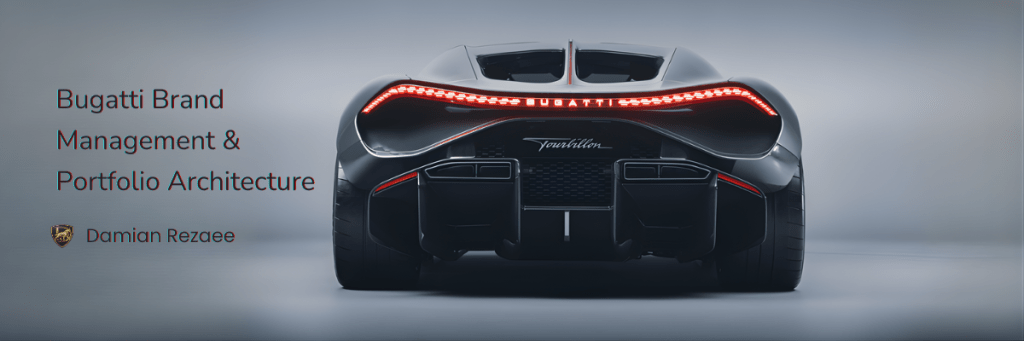
The 2024 introduction of the Tourbillon demonstrates Bugatti’s performance evolution in the electrification era. Rather than abandoning internal combustion, Bugatti developed an entirely new 8.3-liter naturally aspirated V16 engine in collaboration with Cosworth, producing 1,000 PS (986 hp) at 9,000 rpm and paired with three electric motors contributing an additional 800 PS (789 hp), for total system output of 1,800 PS (1,775 hp). This hybrid approach positions electrification as a performance enabler rather than a compromise, with electric motors providing instantaneous torque and torque vectoring while the V16 delivers emotional high-revving character. The Tourbillon’s claimed acceleration of 0-100 km/h in under 2.0 seconds and 0-400 km/h in under 25 seconds reinforces Bugatti’s performance leadership narrative.
Brand Imagery: Heritage, Art, and Exclusivity
Bugatti’s brand imagery transcends automotive performance, positioning vehicles as automotive art objects embodying French cultural heritage, engineering as aesthetic expression, and membership in the most exclusive ownership community globally. This imagery construction draws heavily from Bugatti’s storied history, particularly the Type 35’s 1920s racing dominance (2,000+ race victories), Jean Bugatti’s design masterpieces, including the Type 57 SC Atlantic (considered among history’s most beautiful automobiles), and Ettore Bugatti’s philosophy that “nothing is too beautiful, nothing is too expensive.”
Contemporary Bugatti deliberately reinforces heritage associations through naming conventions and design elements. The C-line flowing along vehicle flanks directly references Jean Bugatti’s 1930s Type 57 SC Atlantic signature design. The macaron emblem featuring Ettore Bugatti’s EB monogram and 60 red dots maintains 1909 original design. Even model names evoke heritage: “Chiron” honors Louis Chiron, Monégasque driver who achieved numerous victories for Bugatti in the 1920s-30s; “Divo” celebrates Albert Divo, French-Italian racer who won the Targa Florio twice driving Bugattis; “Atlantic” commemorates Jean Bugatti’s legendary coupe. This systematic heritage integration creates imagery associations linking contemporary products to historical excellence.
Bugatti also cultivates an automotive art identity through emphasis on craftsmanship, materials, and design. Marketing communications and showroom presentations position the vehicles as sculpture, highlighting hand assembly by master craftspeople, the use of exotic materials such as carbon fiber, titanium, leather, and glass, and a level of detail often invisible to casual observation. The Tourbillon’s analog instrument cluster, designed and assembled by Swiss watchmaker Concepto using more than 600 precision components crafted to horological tolerances, exemplifies this approach by creating an object of functional art that remains timeless even as digital screens become obsolete (Bugatti Newsroom, 2024).
Exclusivity imagery manifests through production limitation, communication, and owner community cultivation. Bugatti consistently emphasizes that Chiron production caps at 500 units globally, Divo at 40 units, Centodieci at 10 units, and La Voiture Noire as a singular creation. This scarcity messaging creates imagery associations of rarity and investment-grade collectibility. Furthermore, Bugatti nurtures imagery of an exclusive community through private events for owners, opportunities to visit the Molsheim atelier, and facilitation of owner connections. This community dimension differentiates Bugatti from mere luxury consumption toward membership in the global elite defined not by wealth alone but by appreciation for mechanical artistry and engineering extremism.
Brand Judgments: Superior Quality and Credibility
Brand judgments represent customers’ cognitive evaluations regarding quality, credibility, consideration, and superiority. In Bugatti’s case, quality judgments overwhelmingly emphasize absolute superiority, which is why Bugatti represents the definitive automotive achievement against which competitors are measured. This judgment derives from performance specifications (horsepower, torque, acceleration, top speed) that consistently exceed rivals, engineering complexity that showcases technical mastery, and build quality that justifies multi-million-dollar pricing.
Credibility judgments benefit from Bugatti’s historical racing pedigree and contemporary performance validation. The marque’s 1920s-30s competition dominance established credibility in performance claims, while modern speed records provide empirical validation that specifications translate to real-world achievement. Importantly, Bugatti backs performance claims with engineering transparency: detailed technical specifications, behind-the-scenes content showing development processes, and opportunities for journalists and owners to validate capabilities through track testing and high-speed runs.
Consideration and superiority judgments position Bugatti at the summit of the automotive hierarchy. Market research among UHNWIs consistently identifies Bugatti as the ultimate automotive acquisition, which is to say the answer to the question, “If you could own any car, which one would you choose?” even among individuals who already own Ferrari, Lamborghini, McLaren, and other exotic marques. This status as the king of the hill creates halo effects that benefit the entire portfolio and justify pricing that substantially exceeds production cost. The Chiron’s €3 million base price, the Centodieci’s €8 million pricing, and La Voiture Noire’s estimated €16.7 million valuation all represent premiums justified not by material cost but by superior positioning in customer judgments.
Brand Feelings: Self-Actualization and Achievement Validation
Brand feelings encompass the emotional responses that Bugatti evokes in both prospective and current owners. Research with Bugatti owners identifies several core emotional dimensions. First, there is excitement and exhilaration derived from experiencing extreme performance in a controlled environment. The visceral sensation of more than 1,500 horsepower, approaching 300 mph, and hearing the distinctive soundtrack of the W16 engine creates an emotional intensity unmatched by conventional luxury goods (Schade et al., 2016).
Second, Bugatti evokes feelings of achievement validation. For successful entrepreneurs and business leaders, ownership represents a tangible manifestation of professional accomplishment and a reward commensurate with extraordinary financial success. Unlike art collecting or real estate acquisition, which are also common among UHNWIs, hypercar ownership offers dynamic engagement because the vehicle can be driven, experienced, and shared with others. This makes it an active rather than a passive display of wealth.
Third, social approval and membership feelings. Bugatti ownership signals belonging to an ultra-exclusive global community, creating affiliation with other owners sharing values around mechanical excellence and engineering appreciation. Owner events, private communications, and shared experiences create community bonds that transcend mere product ownership. Additionally, Bugatti ownership garners social approval and recognition from automotive enthusiasts and luxury consumers more broadly, creating positive social validation beyond the immediate peer group.
Fourth, Bugatti creates feelings of security and permanence. Unlike fashion luxury goods that are vulnerable to trend cycles, or electronic luxury goods that face technological obsolescence, hypercar ownership, particularly in the case of limited production models, offers a sense of long term value retention and appreciation. Bugatti Veyrons initially purchased for $1.5 to $2 million now command $2 to $3 million in secondary markets. Ultra-limited editions such as the Centodieci are expected to appreciate substantially above their €8 million purchase prices. This sense of value security supports positive feelings associated with investment wisdom and long-term wealth preservation.
Brand Resonance: The Pinnacle of Customer-Brand Relationship
Brand resonance, which forms the top of the CBBE pyramid, represents the deepest and most valuable customer brand relationship, characterized by behavioral loyalty, attitudinal attachment, sense of community, and active engagement (Keller, 2001). Bugatti achieves resonance with its core customer base through multiple mechanisms that create psychological bonds extending far beyond transactional exchange.
Behavioral loyalty manifests in repeat purchases and share-of-wallet concentration. Industry data indicates approximately 40% of Bugatti Chiron buyers previously owned Veyrons, demonstrating extraordinary loyalty rates in a context where customers possess dozens of vehicles and unlimited acquisition options. Furthermore, Bugatti derivative models (Divo, Centodieci, Mistral) sold exclusively to existing Chiron owners, with all units pre-allocated before public announcement. This pre-qualification requirement for ultra-limited editions exemplifies behavioral loyalty: customers willing to commit €5-8 million sight-unseen based solely on Bugatti brand trust.
Attitudinal attachment reflects customers viewing Bugatti as special, irreplaceable, and deeply meaningful beyond functional transportation. Owners consistently describe the Bugatti acquisition as a “bucket list” achievement, “dream fulfilled,” and “ultimate goal” rather than as a rational purchase decision. This emotional attachment creates a strong defense against competitive offerings: even superior specifications from rivals cannot easily dislodge Bugatti’s preference once established. Furthermore, attitudinal attachment extends to brand defense behaviors, wherein owners actively promote Bugatti in social situations and correct misperceptions about the brand.
A sense of community emerges from Bugatti’s cultivation of owner relationships through exclusive events, factory visits, and facilitated connections between owners globally. The annual Bugatti Grand Tour brings owners together for multi-day driving experiences through scenic routes, creating shared memories and friendships. The Molsheim factory offers private tours showing hand-assembly processes and a historical collection, deepening owners’ connection to heritage and craftsmanship. Online forums and social media groups enable owner interaction and information exchange independent of company facilitation, demonstrating organic community formation.
Active engagement manifests in customers’ willingness to invest time, energy, and resources in the brand relationship beyond the purchase itself. Bugatti owners participate in brand events despite demanding schedules, share ownership experiences through social media despite privacy concerns, and collaborate with Bugatti on development feedback and customization specifications through the Sur Mesure bespoke program. Some owners maintain collections of multiple Bugatti vehicles spanning generations, display their cars at prestigious concours events and automotive museums, and effectively function as brand ambassadors without formal compensation. This active engagement represents the highest expression of resonance because customers identify so strongly with the brand that supporting it becomes part of their self-concept.
References
Aaker, D. A., & Joachimsthaler, E. (2000). Brand leadership. Free Press.
Ahn, J., Kwon, J., & Sung, Y. (2018). Examining luxury product to service brand extensions: A transfer effect perspective. Journal of Retailing and Consumer Services, 42, 22-31. https://doi.org/10.1016/j.jretconser.2018.01.009
Boisvert, J., & Ashill, N. J. (2018). The impact of branding strategies on horizontal and downward line extension of luxury brands: A cross-national study. International Marketing Review, 35(6), 1033-1052. https://doi.org/10.1108/IMR-04-2017-0085
Bugatti. (2024, June 21). Creating the BUGATTI TOURBILLON [Video]. YouTube. https://www.youtube.com/watch?v=TZR86DsBoG0
Bugatti Newsroom. (2024, June 12). A spark of genius: Electrifying the Bugatti Tourbillon. Bugatti Newsroom. https://newsroom.bugatti.com/en/press-releases/a-spark-of-genius
Gerlach, A., & Witt, J. (2012). Sustainability in the context of strategic brand management: A multiple case study on the automobile industry. In Corporate Responsibility Research Conference. Marseille, France.
Kapferer, J. N. (2012). The new strategic brand management: Advanced insights and strategic thinking (5th ed.). Kogan Page.
Keller, K. L. (1993). Conceptualizing, measuring, and managing customer-based brand equity. Journal of Marketing, 57(1), 1-22. https://doi.org/10.2307/1252054
Keller, K. L. (2001). Building customer-based brand equity: Creating brand resonance requires carefully sequenced brand building efforts. Marketing Science Institute Working Paper Series, 01-107, 1-31.
Keller, K. L., & Lehmann, D. R. (2006). Brands and branding: Research findings and future priorities. Marketing Science, 25(6), 740-759. https://doi.org/10.1287/mksc.1050.0153
Kim, C. K., Lavack, A. M., & Smith, M. (2001). Consumer evaluation of vertical brand extensions and core brands. Journal of Business Research, 52(3), 211-222. https://doi.org/10.1016/S0148-2963(99)00107-1
Riley, F. D., Pina, J. M., & Bravo, R. (2015). The role of perceived value in vertical brand extensions of luxury and premium brands. Journal of Marketing Management, 31(7-8), 881-913. https://doi.org/10.1080/0267257X.2014.989890
Schade, M., Hegner, S., Horstmann, F., & Brinkmann, N. (2016). The impact of attitude functions on luxury brand consumption: An age-based group comparison. Journal of Business Research, 69(1), 314-322. https://doi.org/10.1016/j.jbusres.2015.08.003
Sheinin, D. A., & Schmitt, B. H. (1994). Extending brands with new product concepts: The role of category attribute congruity, brand affect, and brand breadth. Journal of Business Research, 31(1), 1-10. https://doi.org/10.1016/0148-2963(94)90060-4
SkyQuest Technology. (2025). Hyper car market opportunities, share, and forecast [2033]. https://www.skyquestt.com/report/hyper-car-market
Warell, A., & Young, K. (2011). Interior aesthetics: An experience-focused approach for the design of brand-specific automotive identity. International Journal of Vehicle Design, 55(2-4), 278-303. https://doi.org/10.1504/IJVD.2011.038048
 Damian Rezaee
Leave a comment