By Damian Rezaee
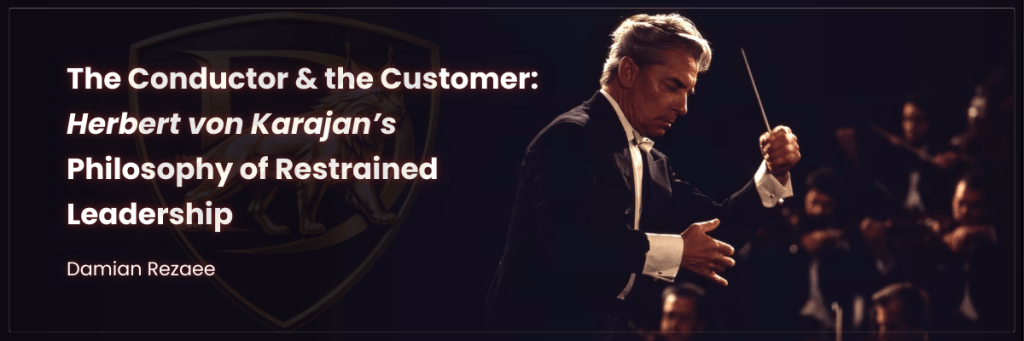
Introduction: When the Baton Disappears
Herbert von Karajan, arguably the most recorded and commercially celebrated conductor of the twentieth century, was famous and famously controversial for one defining artistic conviction: that the finest conductor is one who appears, at the height of performance, to do almost nothing at all. He closed his eyes during performances. He reduced his physical gestures to the barest suggestion. He believed that over-conducting, meaning the temptation to micro-manage every player’s breath and bow, was not a mark of mastery but of insecurity. True authority, in Karajan’s philosophy, did not impose itself at every moment; it had already done its work in the rehearsal room, in the selection of musicians, and in the meticulous construction of a shared interpretive vision. By the time the Berlin Philharmonic lifted its instruments on opening night, Karajan’s job, in the deepest sense, was largely done. What remained was trust.
This conviction, namely that leadership is most powerful when it becomes invisible and that excellence is achieved not through constant correction but through deep prior investment in standards, people, and environment, is not merely a principle of orchestral music. It is, in fact, a remarkably precise model for the management of extraordinary service experiences. The course concepts used to analyze services and experience brands, including Theme and Scheme to Cast, Guestology, Quality Standards, Delivery Systems, Touchpoints as Interaction Points, and the Practical Magic of Setting, share a foundational logic that Karajan lived every day on the podium: the experience that reaches the guest is the product of invisible architecture, not visible intervention (Konson, 2026). This is also the core premise of Disney’s approach to service excellence, which treats the guest experience as the output of deliberate design, disciplined culture, and consistent standards, not the outcome of individual charisma in the moment (Disney Institute & Kinni, 2011). This paper argues that Karajan’s philosophy of restrained, pre-invested leadership offers one of the most illuminating frameworks for understanding why and how world-class service organisations deliver what they deliver.
I. Theme and Scheme to Cast: The Score as the Service Concept
In the experience economy framework articulated by Pine and Gilmore (1999), Theme and Scheme refers to the deliberate construction of a coherent, overarching narrative that organises and gives meaning to every element of a guest experience. A strong theme harmonizes impressions across space, matter, and time. It creates multiple places within a place, and it must fit the character of the enterprise staging the experience (Pine & Gilmore, 1999; Konson, 2026). Theme is therefore not a slogan. It is the governing logic that shapes what is hired, what is worn, how spaces behave, what language is used, and what feelings the organisation is deliberately engineered to produce. Scheme to Cast extends theme into people. The organisation selects and develops employees as performers whose behaviours and instincts align with the intended experience (Disney Institute & Kinni, 2011; Konson, 2026). Disney’s service philosophy makes this cast logic operational by defining what “on-stage” behaviour looks like, training it deliberately, and reinforcing it until it becomes automatic, so the show is consistent even when conditions change (Disney Institute & Kinni, 2011).
Karajan and the Score as Governing Theme
Karajan approached every major work, whether Beethoven’s Ninth or a Bruckner symphony, not as a collection of notes to be executed, but as a unified dramatic and emotional architecture that demanded total internal consistency. Before a single musician set foot on the rehearsal stage, Karajan had internalised the score at a level few conductors attempted. He famously conducted from memory, and this was not showmanship. It was the physical demonstration of a philosophy: the theme must live inside the leader before it can live inside the organisation. You cannot convincingly transmit what you have not wholly absorbed.
In service terms, this maps precisely onto what Pine and Gilmore (1999) describe as the first imperative of theme creation: the theme must alter the guest’s sense of reality. A theme that exists only in a strategy deck alters nothing. A theme that the entire cast has internalised, one that lives in posture, word choice, and instinctive decision-making, reshapes what a guest perceives and remembers. Karajan’s musicians did not simply play the notes he marked in rehearsal; they absorbed his interpretive vision so thoroughly that they could make spontaneous musical decisions during live performance that still remained consistent with the overarching conception of the work. This is exactly the standard that great service organisations aspire to: employees so aligned with the theme that they do not need a script for every scenario. In Disney’s terms, this is the point where employees stop “following instructions” and start “performing the experience,” because expectations have been trained into habits and judgment (Disney Institute & Kinni, 2011).
Casting as Musical Audition
The scheme-to-cast dimension is equally illuminated by Karajan’s selective approach to building an orchestra identity over time. Karajan understood that the most perfect conducting is undermined by a single miscast musician, specifically a player whose instincts, sensibility, or technical capability place them outside the interpretive world the ensemble is creating. This is the service equivalent of the “cast” logic taught through Disney: the organisation is not simply staffing a role, it is staging an experience, and the wrong performer introduces dissonance that customers feel even if they cannot name it (Disney Institute & Kinni, 2011; Konson, 2026). The critical insight Karajan offers is severe but clarifying: theme coherence cannot be repaired through last-minute management. By the time the curtain rises, casting must already be right. Disney’s perspective makes the same point from a service lens: hiring is not only about competence, it is about fit with the standards and the emotional tone of the experience, because guests evaluate the brand through the person in front of them (Disney Institute & Kinni, 2011).
II. Guestology: Knowing the Audience Before the First Note
Guestology is the disciplined study of guests, their expectations, perceptions, behaviours, and emotional needs as the foundation for service design (Connellan, 1997; Disney Institute & Kinni, 2011). The central idea is outside-in design: experiences should be designed from the guest outward, not from internal convenience outward (Konson, 2026). Guestology is therefore not only segmentation and feedback loops. It is the organisation’s willingness to treat guest perception as the truth that the experience must be engineered around. Disney operationalizes this by treating guest confusion, guest friction, and guest disappointment as design signals, then redesigning processes and environments so guests experience ease rather than the organization’s complexity (Disney Institute & Kinni, 2011).
Karajan’s Audience Intelligence
Karajan’s behaviour reflected a sophisticated awareness of how experience is perceived under different conditions. He treated recording as a primary experience format, demanding sensitivity to how music is heard through speakers and in domestic spaces rather than inside a hall. That shift required what guestology requires: redesign from the audience’s perceptual position outward. He adjusted balances, clarity, and sonic spatiality because the guest’s sensory context had changed.
Guestology at its strongest is not only empathy. It is a translation into design. The logic can be stated cleanly. The guest experiences music through perceptual cues such as clarity, warmth, balance, and pacing, and through emotional cues such as confidence and inevitability. Many cues are subliminal, meaning the audience feels quality before it can explain it (Berry et al., 2002). Karajan’s response was not to “perform leadership” harder. It was to redesign the experience so coherence became the default, and then to install that coherence into rehearsal habits and performance norms. This is exactly how guestology becomes operational: insight becomes design, and design becomes standards and process. This matches Disney’s approach, where the goal is not to “save” the experience through last-minute effort, but to engineer it so guests feel guided, understood, and cared for by default (Disney Institute & Kinni, 2011).
III. Quality Standards: The Rehearsal Room as Quality System
Quality standards refer to explicit criteria used to evaluate whether the service encounter delivers the intended experience (Lovelock & Wirtz, 2016). In experience management, quality standards function as a decision compass that guides choices under pressure and protects the coherence of the show (Konson, 2026). Disney’s well-known standards of Safety, Courtesy, Show, and Efficiency illustrate how an organisation can set priorities that keep the experience intact even when conditions are imperfect (Disney Institute & Kinni, 2011).
Karajan’s rehearsal methodology was built on the premise that certain standards are non-negotiable and that the leader’s obligation is to establish them so clearly in rehearsal that they require no enforcement in performance. His standards were not only technical. They were perceptual. His insistence on intonation illustrates the logic of experiential quality standards. Slight pitch impurity can generate discomfort even when the listener cannot name the cause. Service failures operate similarly: guests may not articulate the root cause, but a broken standard produces a felt offness that damages trust. As Berry et al. (2002) argue, experience is shaped by clues, and small negative clues can undermine the total experience disproportionately. Karajan understood this emotionally and operationally: excellence is not mostly excellent. In both contexts, standards are not meant to restrict performance but to protect the guest’s trust, which is what makes exceptional moments possible (Disney Institute & Kinni, 2011).
IV. Delivery Systems: The Invisible Infrastructure of Performance
Delivery systems are the integrated combination of people, processes, and physical infrastructure through which the intended experience is delivered repeatedly under variable conditions (Fitzsimmons & Fitzsimmons, 2014). In experience brands, delivery systems are the scaffolding that makes practical magic repeatable: the setting, the cast, and the process choreography that sustains consistency (Konson, 2026).
The Berlin Philharmonic in the Karajan era can be read as a high-performance delivery system. What audiences experienced, including sonic power, warmth, transparency, and balance, was the output of operational architecture: a large ensemble of elite specialists performing in real time without retakes. That delivery system included seating logic, tuning protocols, rehearsal scheduling, acoustic conditions, and a shared interpretive vocabulary.
Karajan’s major contribution to delivery system thinking is frontstage and backstage separation. The audience experiences effortlessness and inevitability. Backstage contains the discipline that makes effortlessness possible. Service organisations aim for the same effect. The guest sees calm confidence. They do not see training briefings, backstage checklists, process controls, or the preparatory work that prevents inconsistency (Disney Institute & Kinni, 2011; Konson, 2026). Disney’s operational lesson is that repeatable magic requires repeatable systems. The guest should experience ease, not the organisation’s complexity, which means leaders design processes so employees can succeed without heroics and prevent breakdowns before they become visible.
Mini Service Blueprint embedded in the Karajan concert experience
A Karajan concert can be understood as a service blueprint where the most important mechanisms are designed to be invisible. The guest journey begins before the guest enters the building, because awareness and expectations are shaped by programming decisions, reputation, and the implicit promise that a Karajan performance will deliver coherence and inevitability. That expectation is a pre-service touchpoint, but it is also an operational constraint: if the organisation sells transcendence, it must engineer conditions that consistently produce it.
On arrival, the guest crosses the threshold into the setting, and the setting immediately begins to do work. The hall’s lighting, the acoustical character, the spatial layout, and even the social cues of audience behaviour function as environmental instructions that tell the guest how to feel and how to attend. This is frontstage. The guest experiences it directly. But backstage, the same moment is supported by infrastructure: stage management routines, seating and sightline design, acoustic checks, instrument staging, and the labour of many people whose names the guest will never know. The guest reads this as atmosphere. The organisation experiences it as a process.
The concert’s pre-performance sequence provides a clean example of blueprint logic. Tuning is frontstage and is often treated as “not part of the show,” yet Karajan’s philosophy treats it as a quality signal. If tuning feels casual or sloppy, the guest is given a negative clue that undermines trust before the first note. Backstage, this means tuning protocols and norms must exist. It also means roles must be defined: who initiates tuning, how the ensemble settles, how noise is reduced, and how the transition from public preparation to performance is controlled so the first musical moment lands as intended.
During performance, the core frontstage service is the sound and the visible relationship among performers. The guest experiences a living system. This is where Karajan’s restraint becomes a design choice, not merely a style. His reduced gesture vocabulary functions as a frontstage cue that communicates confidence and inevitability. The conductor is present without being noisy. But for that restraint to succeed, backstage must carry much more weight: rehearsal must have installed shared timing, shared articulation logic, shared phrasing, and shared standards for balance. The delivery system is doing the conducting in advance. In blueprint terms, the leader has moved control from the service encounter to the preparation system. The guest sees less intervention and experiences more coherence.
When inevitable variability appears, the blueprint becomes most revealing. In services, variability is guaranteed because humans are the delivery system. In performance, variability appears through acoustics, slight timing shifts, fatigue, or the psychology of a live moment. Karajan’s model does not remove variability. It contains it. Backstage, containment comes from standards and shared habits that allow local autonomy without theme collapse. Frontstage, containment is experienced as flow: the guest feels the performance is alive but still unified. This is the practical magic of a mature delivery system: it absorbs variation without displaying panic.
Intermission and exit function as post-core touchpoints that either consolidate the memory or contaminate it. The guest’s experience is not finished at the last note. It extends through applause, departure rituals, crowd flow, and the post-experience narrative the guest tells themselves and others. A blueprint reading therefore requires that the organisation treat exit processes and transitions as part of the show, supported backstage by staffing, signage, and flow design, so that the experience’s emotional resolution is not broken by friction. Karajan’s insistence on protecting the final resonance before acknowledging applause expresses the same logic: the system must manage transitions to preserve meaning, not rush to the next operational step.
Read this way, Karajan’s disdain for over-conducting becomes a diagnosis of delivery system weakness. Over-conducting is what happens when the system cannot trust its own preparation. It is managerial rescue made visible. Karajan’s stillness is therefore not passivity. It is a visible indicator that backstage has been engineered strongly enough that frontstage can remain calm.
V. Touchpoints Are Interaction Points: Every Note the Audience Hears
Touchpoints are moments of contact that build the experience through a sequence, not a single event (Konson, 2026). Berry et al. (2002) sharpen the logic: experiences are built from clues, and guests form holistic judgments by integrating those clues. For Karajan, every bar, every transition, every silence, and every dynamic shift functions as a discrete experiential moment. He understood the concert as a designed sequence whose ordering and quality determine memory. Disney’s service philosophy treats these interaction points as designable and trainable, because small details accumulate into the guest’s overall judgement of trust and quality (Disney Institute & Kinni, 2011).
Karajan’s obsession with the silence before the first note, the dignity of tuning, and the ritual of taking the stage reveals touchpoint discipline. These are threshold cues that prime attention and set expectation, shaping how all subsequent touchpoints are interpreted. Shostack’s (1984) blueprint logic applies directly: to design a reliable service, the organisation must make the sequence visible to itself, even if it remains invisible to the guest. Karajan’s restraint extends the touchpoint idea further. Sometimes the most powerful touchpoint is deliberate non-intervention. Unnecessary motion can communicate insecurity. Restraint communicates confidence and inevitability. This is touchpoint minimalism: the absence of clutter is itself a clue.
VI. The Practical Magic of Setting: Acoustics as Environmental Design
The Practical Magic of Setting refers to the designed physical and sensory environment through which the experience is delivered and the way setting shapes perception through often subliminal cues (Konson, 2026; Pine & Gilmore, 1999). Setting is not decoration. It cues behaviour, shapes mood, and amplifies or undermines quality. This aligns with servicescape theory: environments influence customer and employee behaviours and shape perceptions of meaning and quality (Bitner, 1992). Disney frames the environment as a cue system that silently guides guest emotions and behaviour, which is why leaders treat cleanliness, layout, signage, sensory atmosphere, and transition zones as part of the experience itself, not background.
Karajan treated performance spaces as experience components, not containers. Acoustics, spatial configuration, sightlines, and atmosphere shape how the guest perceives sound, intensity, intimacy, and immersion. In experience design terms, setting is part of the scheme that makes the theme coherent across the senses, and it must harmonize impressions rather than introduce negative cues (Konson, 2026). Strong themes create multiple places within a place (Pine & Gilmore, 1999). Karajan’s concerts do this through both physical and temporal zones: arrival hush, tuning, pre-first-note silence, intermission reset, post-final-chord decay, and the pause before applause. These are experiential rooms within the larger environment, and they must be protected or the narrative breaks. Karajan’s handling of silence works like environmental design in time: it controls transitions so the meaning of the experience is not broken by premature noise or rushed closure.
VII. Leadership Credo: The Ethics of Invisible Authority
Underlying all frameworks is a leadership philosophy that Karajan clarifies: the leader’s highest function is not to dominate the moment of delivery but to build the conditions under which the experience can be delivered consistently with minimal correction (Konson, 2026). This is the credo of invisible architecture: authority expressed through preparation rather than interruption. In Disney’s terms, leadership is revealed in the consistency of the experience, because leaders shape culture, reinforce standards, and build systems that help employees deliver excellence as a norm rather than an exception (Disney Institute & Kinni, 2011).
Karajan’s credo contains several convictions directly applicable to service management. The leader must hold the whole experience in mind, because leadership is systemic while most roles are local. The leader must invest energy before performance, in casting, training, standards, process design, and environment creation, so the moment of delivery can be trusted to the system. The leader must know when not to intervene, because excessive control disrupts competence. Karajan’s shadow side strengthens the analysis. Remoteness and resistance to feedback reveal a risk: preparation can become arrogance if it stops listening. Guestology must remain active. Without that discipline, systems become brittle.
Conclusion
Herbert von Karajan’s conviction that a conductor should not over-conduct is, at its core, a theory of organisational design: the belief that the highest form of leadership makes itself invisible by preparing the ground so thoroughly that the performance takes care of itself. Applied to Theme and Scheme to Cast, Guestology, Quality Standards, Delivery Systems, Touchpoints, and the Practical Magic of Setting, this conviction yields a coherent model for designing extraordinary experiences.
Theme must be internalised before delivery, not enforced during delivery. Guestology must translate perception into design, and design into standards and process. Quality standards must be embedded so deeply that they create reliability, and reliability creates the capacity for magic. Delivery systems must separate frontstage grace from backstage discipline, so excellence is scalable. Touchpoints must be managed as a sequence of clues that either reinforce or contradict the theme. Setting must be treated as an active participant that shapes perception through sensory and emotional cues. What Karajan teaches the service manager is a discipline of faith: if the work has been done in casting, training, systems, touchpoints, and setting, the leader can lower the baton and trust the organisation to perform.
References
Berry, L. L., Carbone, L. P., & Haeckel, S. H. (2002). Managing the total customer experience. MIT Sloan Management Review, 43(3), 85–89. https://hbsp.harvard.edu/product/SMR082-PDF-ENG
Bitner, M. J. (1992). Servicescapes: The impact of physical surroundings on customers and employees. Journal of Marketing, 56(2), 57–71. https://journals.sagepub.com/doi/10.1177/002224299205600205
Connellan, T. K. (1997). Inside the magic kingdom: Seven keys to Disney’s success. Bard Press. https://www.goodreads.com/book/show/266232.Inside_the_Magic_Kingdom
Konson, A. (2026). Considerations for services, retail and experience brands [PowerPoint slides]. Schulich School of Business, York University.
Kotler, P. (1973). Atmospherics as a marketing tool. Journal of Retailing, 49(4), 48–64. https://www.semanticscholar.org/paper/Atmospherics-as-a-Marketing-Tool-Kotler/569889e03d9455559721175f2668b3087c9b15dd
Lebrecht, N. (1997). The maestro myth: Great conductors in pursuit of power. Citadel Press.
Shostack, G. L. (1984). Designing services that deliver. Harvard Business Review, 62(1), 133–139. https://hbr.org/1984/01/designing-services-that-deliver
 DamianRezaee
Leave a comment